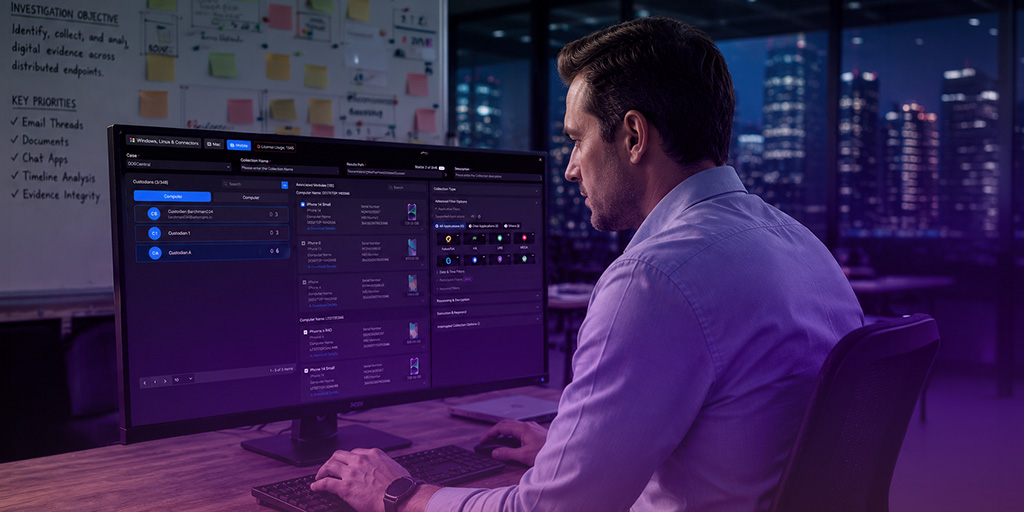
Why Generic Security Copilots Can’t Run Endpoint Forensics (And What Does)

Authored by Robert Bond, Senior Marketing Manager, Digital Forensics, Exterro
Almost every enterprise security tool now comes with a chat box in the sidebar. You paste in an alert, and the model summarizes the CVE entry, explains the MITRE ATT&CK technique, or drafts a generic remediation script. For tier-1 triage or routine research, that is fine. But during an active intrusion or a forensic investigation, conversational AI hits a brick wall.
Ask a security copilot if a suspicious PowerShell execution on a domain controller dumped credentials, and it will likely tell you how credential dumping works and suggest commands you should run. Without connected forensic tools and permissions, it cannot reach into that live server, parse the memory space, inspect unallocated clusters, examine the Master File Table (MFT) and the separate NTFS USN change journal, and look for evidence of access to NTDS.dit.
Reasoning without execution authority is just conversational drag. When you are dealing with active lateral movement or are preparing to report on an incident to executive leadership or regulatory authorities, you do not need an assistant asking you to write queries or copy-paste scripts across consoles. You need an architecture that turns investigative intent directly into forensic execution on the host.
That disconnect—and the architectural blueprint needed to solve it—is the focus of the new Exterro whitepaper, From Alert to Evidence: Transforming DFIR Operations with Intent-Driven Execution. If your team is evaluating AI tools for incident response, the whitepaper breaks down why conversational wrappers fall short and how agentic orchestration changes the calculus.
The LLM Wrapper Illusion
A security copilot connected only to an EDR or SIEM database has a limited evidence view. The model can only see what the telemetry pipeline has already collected and forwarded.
Telemetry supports detection, containment, and investigation, but does not necessarily provide a complete evidentiary record. EDR telemetry streams process creations, network connections, and file modifications. Telemetry alone may not preserve the additional forensic artifacts required when legal counsel or cyber insurance underwriters ask for proof:
- Telemetry alone cannot inspect unallocated space where an attacker staged and deleted files, where remnants remain recoverable.
- Telemetry alone may not include NTFS USN journal records or the historical content available in Volume Shadow Copies.
- Telemetry alone cannot acquire RAM for analysis of decrypted payloads or signs of process injection.
- Telemetry alone does not establish chain of custody; collection, integrity checks, and evidence handling must be documented.
When the high-level logs leave gaps, a copilot limited to those logs cannot fill them. It can summarize an alert, but without connected forensic tools, it cannot run a forensic inquiry on the machine where the evidence actually lives.
The Race Against Volatile Evidence Decay
The limitation of passive copilots becomes critical when dealing with modern adversary tradecraft.
Threat actors can live off the land (LotL), run malicious payloads entirely in memory, leverage ephemeral staging paths, and script automated log wipers. In that environment, evidence degrades fast:
- Current network connection state and injected code may be lost as volatile memory changes.
- Automated wiper scripts can clear event logs and delete temporary directories during an attack.
- The preservation risk: Rebooting or powering off an endpoint can destroy volatile evidence, including injected payloads and decryption keys. Network isolation does not itself erase RAM, but it can interrupt remote forensic access. Coordinate preservation with containment without delaying action needed to stop ongoing harm.
Traditional forensic workflows require an investigator to manually write a collection script, request administrative access, deploy an agent, or wait hours for a massive raw disk image to crawl across a WAN. While analysts wait, the host reboots, logs roll over, and the window to capture the truth shuts down. A chatbot offering tips while that happens does not solve the problem.
Architecture Matters: Model Context Protocol and Intent-Driven IR
Bridging this gap requires moving past the chat interface and adopting an agentic execution model.
Rather than treating AI as a separate conversational tool, Exterro's agentic AI system, ARMOUR, serves as an architectural framework for the agentic execution of forensic tasks through natural language conversation. Instead of hand-crafting complex queries or manually sequencing multi-system collections, an investigator communicates the investigative objective in plain English:
"Determine whether the unauthorized login on Host-04 moved laterally to the domain controller, inspect volatile memory for credential dumping, and check for outbound staging."
Model Context Protocol (MCP) connects supported AI models to Exterro’s forensic tools. Within configured permissions and approval rules, ARMOUR translates that plain-language objective into a structured, multi-step execution plan across live enterprise endpoints:
- Direct Fleet Orchestration: ARMOUR coordinates target endpoints simultaneously without requiring the analyst to script individual machine queries.
- Live Memory and Artifact Extraction: Where supported, Exterro technology captures volatile memory, pulls relevant registry hives, and parses Master File Tables —helping gather critical artifacts before they can be wiped or degraded.
- Automated Timeline Synthesis: Disparate artifacts from multiple machines are indexed and correlated into a single, chronological timeline that highlights initial access, user activity, and lateral hops.
The analyst stops acting as a manual tool operator and focuses entirely on validating the evidence and directing response strategy.
Why Deterministic Engines Must Back the Reasoning
Large language models excel at processing language and decomposing complex requests into logical steps, but they should never be trusted to parse binary data or raw file systems on their own. Asking a generative model to interpret raw memory buffers invites hallucinations—an immediate liability in any regulatory disclosure or litigation.
This is why ARMOUR separates cognitive coordination from forensic execution. The agentic reasoning layer determines what needs to be investigated, but the actual execution is handed off to dedicated forensic engines:
- Deterministic Forensic Parsing: Dedicated forensic code acquires memory, processes MFT structures, and verifies file hashes. The AI does not guess at data offsets; the underlying engine computes them deterministically.
- Evidentiary Traceability: Findings presented by ARMOUR should be checked against the supporting evidence and source context; investigators must verify what was collected and preserved.
- Human-in-the-Loop Oversight: The framework does not make consequential business decisions or deploy unguided containment scripts on its own. It carries out the heavy technical labor, synthesizes the findings, and hands the results back to senior investigators for final review and sign-off.
Moving from Conversation to Execution
The measure of AI in security operations cannot simply be how well it summarizes an alert you already understand. In high-stakes incident response, its value is defined by whether it can safely and rapidly extract defensible facts from the endpoint before evidence decays.
Generic copilots offer conversation; intent-driven orchestration delivers execution.
To see the technical architecture, workflow comparisons, and enterprise incident response scenarios in detail, download the whitepaper: From Alert to Evidence: Transforming DFIR Operations with Intent-Driven Execution.
If you want to see how natural-language intent translates into live forensic execution across your fleet, schedule a technical demonstration with our team.