Exterro believes AI should do more than return answers. It should help legal and compliance work move forward more autonomously, with stronger governance, greater control, with people involved where oversight matters.

Today, most AI is being used to answer questions and summarize data. Exterro sees the bigger opportunity in reducing the manual coordination, disconnected handoffs, and process drag that slow legal and compliance workflows down every day.
Exterro’s vision for a more autonomous, orchestrated, and defensible way to move work forward.

ARMOUR is Exterro’s framework for a new era of legal AI, where systems do more than respond. They act.
ARMOUR (Autonomous Risk Management, Orchestration, and Unified Response) is Exterro’s framework for that shift. Exterro believes AI should do more than assist at the task level, it should: identify risk, apply governance, and trigger defensible actions automatically across a unified platform. By replacing disconnected tools and fragmented handoffs, ARMOUR cuts cost, reduces outside counsel dependence, and brings more control to high-stakes workflows.

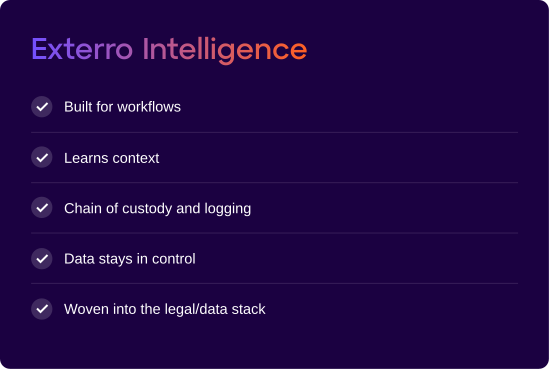
For legal and risk teams, autonomy without control is a liability. The ARMOUR framework is designed so automation never comes at the cost of trust: sensitive data stays in its source environment, actions happen within a controlled architecture, and human judgment is built in whenever strategic discretion is required. This is enterprise AI built for scrutiny, not just speed.
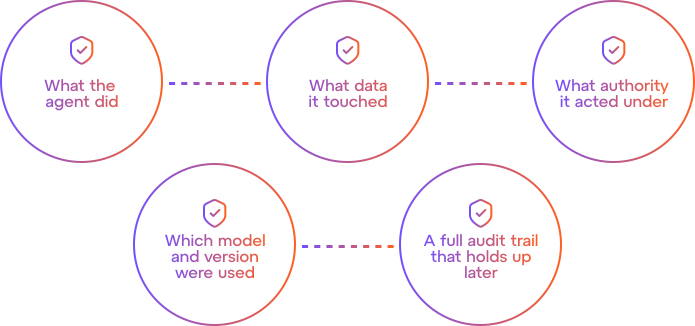
In legal and risk environments, every automated action must be visible, traceable, and reproducible under scrutiny — with an immutable audit trail that can stand up months or years later. That is where Exterro is built to stand apart.
The ARMOUR Autonomy Ladder maps the path Exterro is charting from manual, fragmented work to governed, autonomous execution.

Exterro Subpoena Manager applies autonomous orchestration to subpoena response, replacing a slow, manual, handoff-heavy process with a workflow that is faster, smarter, and more controlled.
This vision only works if the underlying foundation is already there. Exterro brings the unified platform, enterprise connectivity, and legal-grade control model needed to make autonomous execution credible, controlled, and useful in the real world.

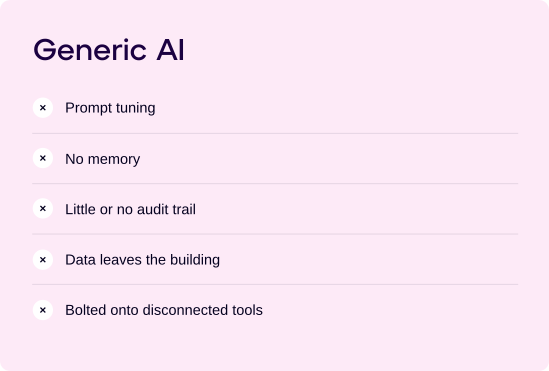
Most legal AI lives in a silo. It may be useful for prompts, but not for autonomous work that has to move across real systems and data. Exterro is different because its AI is grounded in real enterprise context – your matters, your data, and your workflows – with the industry’s most robust connector sets giving agents access to the systems, tools, and context the work actually depends on.
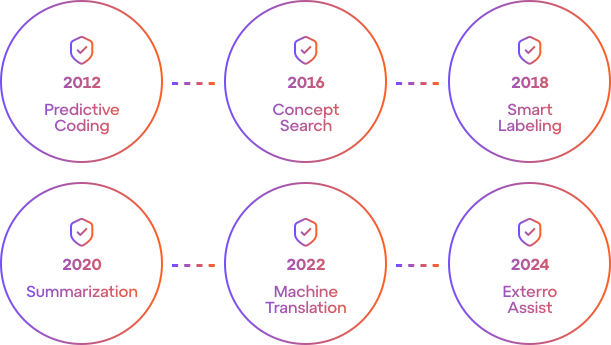
Exterro has consistently moved early on emerging AI capabilities and translated them into real innovation for this category. That matters even more now, because the pace of change is accelerating. What sets Exterro apart is not just early innovation, but the ability to keep leading as the category evolves.