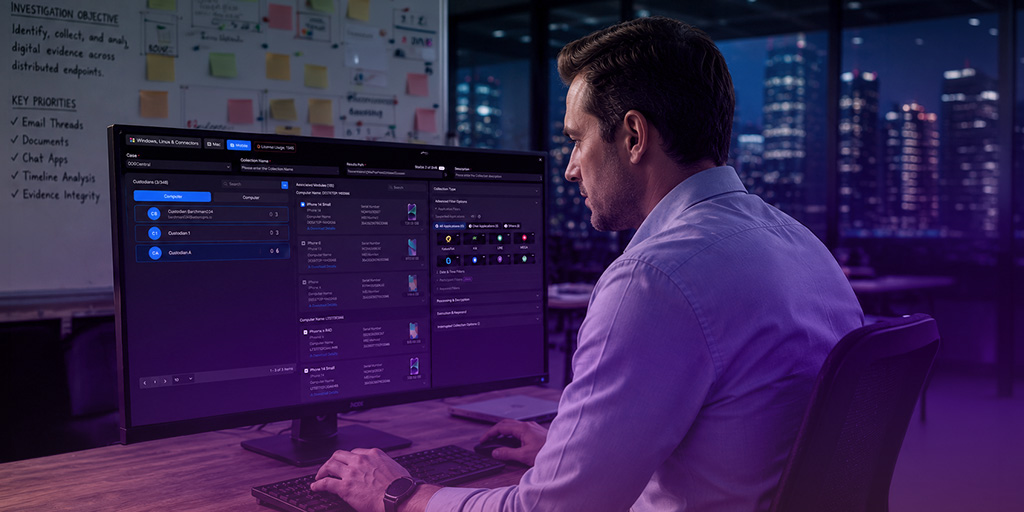
Navigating Modern Investigations with an AI Compass

A crisis never announces itself. One moment your operations are running perfectly normally, and the next, your investigators, security teams, legal counsel, and executives are racing against a ticking clock to answer a single, high-stakes question: What happened?
For years, many organizations relied on a passive "wait and see" strategy when it came to data breaches, insider threats, or regulatory pressures. But in today’s hyper-connected landscape, that approach is no longer going to fly.
In an episode of the Data Xposure podcast featuring Harsh Behl, Vice President of Product Management for Digital Forensics at Exterro, he and host Michael Hamilton discussed the real-world benchmark set when federal investigators responded to an attempted assassination at the White House correspondents' dinner. They had less than 48 hours to build a complete picture of the suspect's intent, planning, and actions across millions of digital artifacts. Their success under extraordinary time pressure completely raises the bar for all organizations, including enterprises, not just public sector or law enforcement agencies. If high-tier investigative bodies can cut through terabytes of data in two days, corporate leaders can no longer afford to be caught scrambling to build an investigative process in the middle of a corporate emergency.
For more insights on the future of AI in digital forensics and rapid risk response, tune into the full conversation with Harsh Behl on the Data Xposure Podcast.
The Trap of Data Silos and Massive Scale
Today, every individual leaves behind a massive digital footprint. Corporate investigators are no longer just looking at a few gigabytes of data; they are routinely forced to confront terabytes of information spanning mobile phones, laptops, cloud repositories, and chat applications. However, the primary challenge of an investigation isn’t just the sheer volume of data. It’s connecting the dots.
Traditionally, organizations have relied on separate, siloed point solutions to examine specific data sources (such as analyzing a mobile device entirely apart from a laptop). But analyzing evidence in a vacuum makes it incredibly easy to miss critical insights. To uncover the truth, teams must be able to correlate system data with user behavior holistically. For example, layering a phone's Wi-Fi connection history directly over a photograph's geolocation data can instantly map out exactly where a user was and what access point they connected to—providing vital context that separate silos would keep hidden.
AI as the Ultimate Map and Compass
To survive this exponential explosion of data without letting backlogs pile up, organizations must evolve their modus operandi. This is where AI steps in—not to replace the human element, but to act as a vital map and compass. The human investigator remains firmly in the loop, but AI grants them an exponential head start.
Modern digital forensics platforms leverage AI to turn overwhelming data sets into actionable intelligence in a fraction of the time:
- Smart Multimedia Analysis: Instead of forcing examiners to watch hours of video or CCTV footage, AI enables semantic and keyword searching. This allows investigators to instantly isolate the specific mini-clips that contain relevant content.
- Rapid Document Summarization: Rather than reading through a 50-page document or endless chat streams, investigators can utilize AI-generated summaries to quickly determine if a file warrants a closer look.
- Entity and Context Extraction: Advanced AI tools can automatically extract entities—identifying specific people or organizations being referred to in communications—and even analyze the mood or topic of interest discussed by the participants.
By shifting the heavy lifting to machine intelligence, investigations that used to take weeks can be completed in days, and tasks that took days can be resolved in a matter of hours.
Centralizing the Best-of-Breed Tools
Utilizing AI effectively does not mean hunting for a single silver-bullet platform that claims to do everything natively. The forensic community relies heavily on validation before presenting evidence. Therefore, the most effective approach is to maintain a centralized platform that integrates best-of-breed solutions.
By deploying a centralized hub, an organization can pull together mobile, computer, and cloud data from various specialized tools into one unified space. This allows separate internal teams to collaborate live on a single case, slice and dice data efficiently, and ensure they aren't processing the exact same data three or four different times.
Prove Your Investigative Readiness Tomorrow
The ultimate lesson from high-pressure federal environments is clear: the organizations that successfully mitigate risk are rarely the ones scrambling to construct a workflow during a live crisis. They are the ones that proactively invested in investigative readiness before the emergency ever began.
Tomorrow morning, every CISO, CIO, and General Counsel should ask their teams three fundamental questions to evaluate their readiness:
- Are we equipped to answer critical executive and technical questions immediately when a data breach occurs?
- Do our internal labs have the right tools, frameworks, and specialized skill sets to handle terabytes of data under intense pressure?
- Are our teams still losing valuable hours manually correlating artifacts across separate data silos?
Your organization's data is undeniably its greatest asset. But if you lack the technology and frameworks to find, understand, and act on that data when it matters most, it will quickly become your greatest risk.
Discover how modern forensic frameworks turn massive scale into actionable intelligence. Read the full breakdown of the federal investigation here.