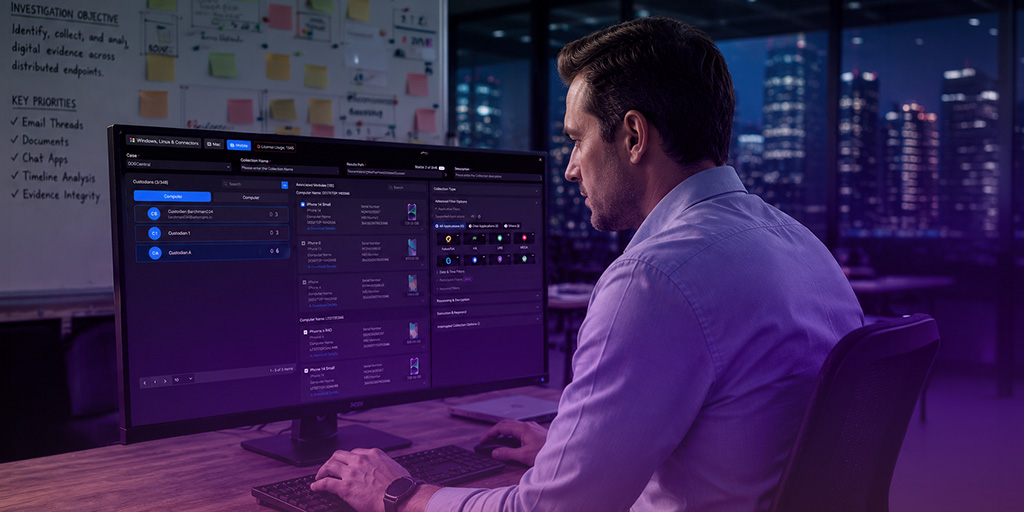
See how the FBI beat the clock on the Trump WHCA Assassination Case with Exterro FTK.
Read the case study


When Legal Hold, Privacy and Retention Hit the Same Data: Building an eDiscovery Program That Holds Up | Data Xposure - Ep 25
Host: Mike Hamilton, VP, Marketing - Exterro
Guest: Nick Curtis, eDiscovery Manager - Tokio Marine HCC
The same data can sit under a litigation hold, subject to a privacy request, and on a retention schedule at once, with cross-border restrictions on top. Most eDiscovery programs are built to answer one of those well, and the conflicts only surface when a second request arrives.
Host Mike Hamilton talks with Nick Curtis, eDiscovery Manager at Tokio Marine HCC, the Houston-based specialty insurance group. Nick has built and run these programs from both sides, service provider and corporate, and has watched more organizations attempt it than most people in the field.
What does it take to stop looking at data through a purely eDiscovery lens and start asking where it lives, who owns it, and which obligations attach to it? How do you design workflows, policies and procedures that hold up when legal, privacy, compliance and security all have a claim? Which decisions have to be made before the technology lands? And how do you get a team self-sufficient enough that the process survives the person who built it?
Nick also traces how the program at Tokio Marine HCC matured over time. Legal holds that once took significant manual coordination now go out in minutes, the team has far better visibility into where data actually sits across the enterprise, and a significant share of document review has come back under the legal department's control. Technology made those gains possible, but the drivers were governance decisions, redesigned workflows, and getting legal, IT and compliance aligned on who owns what.
For eDiscovery and legal operations managers, information governance and privacy teams, and anyone responsible for data that more than one department has a claim on.
Apple Podcasts | Spotify | YouTube
Mike Hamilton (00:02)
Hello Nick, welcome to Data Xposure Great to have you on the program.
Nick Curtis (00:06)
Thank you, thank you. I'm happy to be here.
Mike Hamilton (00:09)
Well, we're really excited to have you on. I got a whole list of questions for you today, Nick. So let's just start at, you know, a very baseline level. Tell us what you do at Tokio Marine on a day-to-day basis.
Nick Curtis (00:23)
Yeah. I'm the eDiscovery manager. My primary responsibility is helping the company with data, the identification, preservation, collection, review and processing of data for litigation primarily and internal investigations. So I I work primarily with the legal team attorneys, paralegal. I also work with various personnel.
such as HR, IT security, data privacy team. also my responsibilities include the policies and procedures and setting up workflow for our department and particularly in eDiscovery. I also deal with training. that's one thing. I am the subject matter expert, so I'm the person they come to
when it comes to eDiscovery. I also work with vendors maintain those relationships with the different vendors we have, also responsible for managing our legal technology that we use and making sure that I work with doing the updates, upgrades
making sure we have the technical infrastructure like servers and any different you know laptops or any different type of of hardware we need. So that's what I do kinda on a day to day basis. it's everything to deal with e-discovery. I am the person they come to when they have questions regarding e-discovery. And so that that's what I do on a day-to-day basis.
Mike Hamilton (02:16)
And so that's a lot of stuff that you just talked about, Nick. So how how much of that is put on you and how many people do you go to help support those activities?
Nick Curtis (02:28)
Yeah, I try to concentrate on the the highest level, the things that really are specialized. So some of the day-to-day operations around collecting data, preserving data, I have my team work on that where I can focus on some of the the higher level stuff, making sure we have everything we need, and making sure we have standard
operating procedures, being at that face when talking internally, whether that's with, you know, internal personnel or dealing outside the company with vendors, and you know, just being that that kind of face for the company. So I kind of focus more on on on the higher level stuff, besides the day to day, you know, operation of like collecting, preserving data.
Mike Hamilton (03:27)
So how big is that team that supports you?
Nick Curtis (03:31)
right now we have two attorneys, paralegal, e discovery specialist, myself the e discovery manager. So at our core we have five people. we may bring in an additional person as as needed, but the core right now consists of five people.
Mike Hamilton (03:48)
Okay. Nick something that stood out to me about you was how you worked both on the service provider side and the corporate side. So I I think it gives you a really interesting perspective. What did you understand about corporate legal teams only after you started at Tokio Marine?
Nick Curtis (04:11)
One of the major things I I recognize is just the need for information governance and being
Mike Hamilton (04:16)
Mm.
Nick Curtis (04:17)
a able to identify data. That's that's the biggest thing. Because when you're on the service provider side, a lot of times you just really see the data. It it comes to you and your your process, you're collecting and processing the data. and also maybe set maybe setting up reviews and doing productions.
But on the corporate side, you really have to understand the information governance, the structure of the company, and how data flows throughout the company. So that's one of the biggest things is just knowing how the date where the data resides, how the data is is is governed, and how to be able to identify what needs to be preserved and what needs to be collected. So
That's that's one of the major things. The other major thing, and this is a big thing from a business perspective, is that when you're on the corporate side, usually you're not a revenue generating operation. You know, generally you're you're costing the the the the company because the company is not making any revenue from the legal side, which is different from the services side, in which you're you're you're generating a lot of revenue. So that place is
An emphasis on being able to be efficient in saving the company money in particular areas. I can give you an example. Like something as simple as selecting the right forensic vendor can be
Mike Hamilton (05:45)
Mm.
Nick Curtis (05:46)
a major difference. at the end of the day, you have to be able to do things effectively and right. So in selecting a mate forensic vendor, in case you select the wrong vendor, you may have to go back and
redo the work, contract out another vendor, doing the work twice. And so that's double double the cost. So you you just have to be really efficient on the corporate side when it comes to how how you operate because you you are generally not a revenue producing part of the the company.
Mike Hamilton (06:25)
What's interesting also to me, Nick, is I mean, you're talking about information governance. To me, that's a sign that you're you have a very mature process over you over at Tokio Marine. You know, on the provider side, you saw a lot of different types of departments in different levels of maturity. What did the good ones in your opinion have in common? Like I I mean, when you were on the p service provider side, did you know, like, hey, like if they know their data, like
That means that they have their processes in line. Like, was there anything that stood out to you?
Nick Curtis (07:01)
Yeah, well one of the thing major things is you you can kinda tell basically on the data delivery and how how they give you the data. Usually if it's structured neat and properly, usually that's an indication of of good information governance and good identification and collection of data. And so that's why you generally g can get a good handle on
you know, the the data, the the format that it's delivered in. Is it is it clean? how how it was collected. 'cause a lot of companies they they use they have their internal forensics, for example, that may provide it to you. So it it may be a a clean version of the data. And so j you you can get hints through communication and through also how the data is provided to you on whether or not
a company has a good hold on on how they recognize data and how they they govern the data.
Mike Hamilton (08:08)
And and it's so important in today's day and age, especially with everyone leaning into AI tools, how AI is actually taking data out of an organization and leveraging it. we've kind of seen that in the news so far. And I think we'll talk more about AI here in a s in a little bit, but I want to get kind of to the meat of this podcast episode. So walk me through what happens when a legal hole lands on data that's also in scope for something else, like a retention schedule.
or a privacy request. Who finds out and how?
Nick Curtis (08:43)
Yeah. yeah, they can be competing or conf or different obligations. So for example, you can have a data on a legal hold that's also subject to a data subject request. You know, if someone submits and says, Well, we want our our destruction of our private data.
Mike Hamilton (09:09)
Mm-hmm.
Nick Curtis (09:09)
But
some of that data may exist and need to be preserved for a legal hold. So now you have competing obligations. and that situation is based upon doing a observation on which obligation takes precedence.
Mike Hamilton (09:25)
Mm-hmm.
Nick Curtis (09:26)
So there there needs to be some kind of collaboration and communication with other groups, especially like data privacy.
information governance team, IT security team. And so it's situations where you may come across data that has different obligations and you have to determine which one takes precedence. And so
Mike Hamilton (09:57)
Mm-hmm.
Nick Curtis (09:58)
we've had a situation like that before where kind of the legal hole took precedence and we needed to preserve
for legal hold purposes, litigation purposes.
Mike Hamilton (10:11)
So who who's the person that notices the conflict? Is that like an automatic trigger that's in a system somewhere? Or does that boil down to someone like yourself saying, Hey, we have these things crossing wires, what do we do?
Nick Curtis (10:27)
Yeah, it it depends. Sometimes you're able to recognize those ear early, right, before you even really get into into it. But sometimes it you get into the process and you realize, well, we have this on a on a litigation hole and they're asking. and so that it gets triggered. So it really depends. if you have a good program, you can
lot of times, you know, f address that problem and see it beforehand before you even get into any type of of work on it. So it really depends upon the scope of how how good your data governance is and how, you know, all your data privacy and your how you are with cro cro dealing with recognizing that, you know, it's cross border obligations.
thing and, you know, your your legal as far as legal holes and preserving data.
Mike Hamilton (11:35)
Mm-hmm. Okay, that makes sense. I want to circle back because I know the kind of the common theme of this episode so far is data. And you described looking
Nick Curtis (11:44)
Mm-hmm.
Mike Hamilton (11:45)
at data across four things, if my memory serves me correctly. Where it lives, how it's secured, privacy obligations, and then some cross-border rules. In your opinion, what causes the most trouble in practice?
Nick Curtis (11:59)
I definitely say it's the I would say two of really, the privacy obligation and and cross border requirements. I think those are probably the two hardest. Just because think you you know you can you can know where the data exists and reside. companies are becoming better at, you know, being able to map data and know where the data is at. But
You know, those requirements and the data privacy obligations, those are those are changing. And it's you know something that's not it's something that keeps it keeps changing, but it's something that everybody is not aware of. So there's different privacy laws in different states and those get updated, but people are barely made aware of the various updates. There's really no
you know, kind of notification that is delivered. So that that's kind of the the hardest thing. And it it's kind it's being updated and you have to be aware of those. I would say also those are the things that take precedent for me. I would
Mike Hamilton (13:14)
huh.
Nick Curtis (13:14)
I would if I would have to set my priorities, I would say that the cross border requirements and the data privacy
obligations I I would put that as far as data I will put that number one actually and then
Mike Hamilton (13:28)
Mm. Interesting.
Nick Curtis (13:30)
two I would put security concerns probably the second and then third I would probably put information governance it's like knowing where data resides where it's housed at where it lives and then I will put the collection part of it
and preservation part of it like fourth.
Mike Hamilton (13:55)
Mm.
Nick Curtis (13:55)
So I would say the it's a it's very important for the cross border n requirements and the data privacy re requ obligations to to to put those as a precedent.
Mike Hamilton (14:10)
So those are like the foundational bre bedrock type of things that you have to understand before you can think about how you manage your data, how you're gonna collect your data. So,
Nick Curtis (14:22)
Yes.
Mike Hamilton (14:23)
okay. One thing on our prep call that we talked about, Nick, is you said you could talk pretty endlessly about building workflows, writing policies and procedures, not the software per se. Why is that the case?
Nick Curtis (14:41)
Yeah, well well the software is just it it's an a I would say it's an an enhancement or
Mike Hamilton (14:47)
Mm.
Nick Curtis (14:48)
it's your it's the efficiency. It helps with efficiency on already established processes. So the the process and the workflows is where you really have your efficiency and really do the you know the good work. If you if you don't have
a good process or good workflow, then the technology doesn't really matter.
Mike Hamilton (15:16)
Mm-hmm.
Nick Curtis (15:17)
At the end of the day, you want to be able to produce good work. And so you have to have a process, you have to have a workflow that enabled you to be able to produce, you know, good good work and good outcomes. You know, it's really about pro providing and doing job efficiently. And if you don't
Then you have all types of problems. You know, you may have to do double the work and and rework things. it also establishes continuity. So you have continuity within your department, continuity within the the team, so people know what to do to handle certain situations. So it provides a good foundation to be able to be efficient and do things properly.
So the the technology is just a a means of of carrying that out. So I always put the workflow and the policies and procedures before that because you have to have that so solid foundation to actually know what to do and how to go about it. And a technology is just a way to help you do that.
Mike Hamilton (16:31)
Mm-hmm. That makes sense. And so essentially you want you don't want the technology to determine your process. You want the process to enhance you want the technology to enhance your process.
Nick Curtis (16:43)
Yes, exactly. I thought
Mike Hamilton (16:45)
Yeah. Yep.
Nick Curtis (16:46)
about this the other day. because sometimes you get vendors and different companies want to show you the newest technology. And sometimes I look at it, I'm like, okay, that's a great technology, but we don't really have a use for it.
Mike Hamilton (17:02)
Yeah.
Nick Curtis (17:03)
so it's it's one of those things where you know the technology could be great, but if if it doesn't have a
a use for what you're tr or trying to do, then you know, it's not applicable. So
Mike Hamilton (17:17)
Yeah, the technology needs to be flexible. And that leads me to my next question. So I want to talk about you've had somewhat of a change at Tokio Marine, right? you know, you moved off a more or an older setup and you changed how people worked. Can you talk about how you've conducted change management at Tokio Marine? and what the effects of that were.
with your new process that you've implemented.
Nick Curtis (17:49)
Yeah, I I think the biggest thing about it is people are able to see e discovery process and how it is connected. I think the way we have the setup in Exterro is about a different like modules or or platforms.
And
Mike Hamilton (18:08)
Mm-hmm.
Nick Curtis (18:09)
there's a inter connectedness with it with all of it. And so everyone is able to to to see how everything
comes together and the different process is integrated as before where we had the one platform but it it had the different pieces but it wasn't in a in a way visually that you could see the different platforms. You would just click on the button at the top and they have the different little tabs at the top. But I think the way the Exterro is set up, the way you can see when you log in the different platforms and different pieces, you can be able to see
different aspects and then see how kind of they all come together and related. So I think that that's been a big help in everybody being able to understand the the processes and how each component comes together to to make the process complete.
Mike Hamilton (19:08)
Mm-hmm. Mm-hmm. And you did a ton of work, right? Building out this new process in in I think, you know, what you've noted is like you wrote manuals, you recorded trainings, so the so the team really could run without you having to manage every bit and piece of it. Can you talk about what the effects of you doing that work?
Nick Curtis (19:33)
Yeah, it it made everything, you know, more efficient. it made it to where everybody can be able to to pick up things and and run with it.
Mike Hamilton (19:44)
Mm-hmm.
Nick Curtis (19:46)
and it also made it to where it wasn't just me having just being the only one having the knowledge. So it made it easier for other people to be able to come in and and do things and do consistently and and be proactive.
and and doing things and freed up time for me to do you know other tasks other related other things and so it it also increases confidence of your coworkers and colleagues they'd be able to to being able to do the process consistently learn it and so that's another thing that was that was big and being able to just see how
how things come together. So I think the biggest thing was I'm being able to, you know, spread that knowledge and not just being the only person of knowledge and being able to to focus on other things and being able to, you know, take some time off and not be worried about whether or not, you know, they can they could handle things in case I wasn't available.
Mike Hamilton (21:02)
Sure.
I I I think that's one of the biggest parts of change management is adoption. And a lot of times we see some departments buy software and they don't go through that rigorous process of building a that adoption and educating other people on the team to leverage the co the technology. And the technology just sits on its shelf, right? Like no one's leveraging it. And if let's say Nick were to go away, then no one would be able to leverage Exterro
Right. But it sounds like you set up that process so you're getting more adoption internally. People are seeing the benefits of leveraging the software. And you don't have to be the one doing all the work all the time. Right. Yeah.
Nick Curtis (21:46)
Right. Right.
Yeah. It it's it's really great. I I think the biggest thing is making sure that you know everyone knows how to do their part. I think one of the biggest things I I've done also is is and Exterro has done a great job of of the releases. So I've I've gone into every time they have the release
they send out the documentation for it and going out and looking at documentation and seeing what's relevant, and updating the team so so they are aware of it. So w we have a lot of training manuals, a lot of Exterro kind of like the Exterro they send out a lot of documentation. So we have that documentation and any type of updates, I go in and, you know, if needed.
if it's applicable to our workflow when they do the new releases to let the let the team know. And so that that's how I'll keep them updated on any type of updates and new releases in Exterro
Mike Hamilton (23:00)
So where would you say that Exterro has made the biggest difference for your team right now? Which workflows, which which business outcomes have you experienced where you're like, this unlocked something for me?
Nick Curtis (23:15)
Yeah, I I think the biggest thing is something that's really underrated. I think is the two two particular things that strike out is the HR mapping and the data source discovery. I I think those are two huge things. especially the the data source discovery allows us to go in and look at the different the data sources, particularly the most the most popular ones that
that we collect from the exchange and one drive and network file shares the the personal shares those those have been huge for us and being able to automatically have that and and collect from that has been wonderful also with the that that kind of works hand in hand with the HR mapping which
you know, populates with the employee information. So you you have the employee pre populated when you go in to you know send out a legal hold or collect data. So though those have been huge. I I think altogether Exterro has a has a great offering. and they've really tried to concentrate on making a an end to end
e discovery platform. And so that that piece of it is kind of big because it's more focused on the the left side of the e-discovery reference model. And so it r it really helps us with already having that information in in our system.
Mike Hamilton (25:01)
It kind of goes touches back on what you said, right? around information governance, knowing your data, being able to identify where your data lives, yeah. It seems like a lot of people are really focused on the right hand side. And over the past three or four years, people have been like, Let's move back and start at the beginning and sort of treat it as a funnel, right? If we can narrow that funnel a little higher up on that funnel, it's gonna save you time, money.
make you more efficient. What would you t tell someone if they're evaluating a software platform right now? Like w what's what should they be looking for?
Nick Curtis (25:45)
I think they should be looking at the the primary thing first focus on
The software and and how it it helps their workflow.
Mike Hamilton (25:56)
Mm.
Nick Curtis (25:56)
it goes back to what I l said a little bit earlier. you can have great technology, but if it's doesn't help your workflow and it's not applicable to what you're trying to do, then it doesn't matter. So I I think that's the first aspect of it. It's to to evaluate, you know, how does the technology fit in what we're we're trying to do, what we're trying to accomplish. And so
I I think that's kind of the first thing. And then once you're looking at that, you're looking at how okay, well, how does it increase the efficiency in that area of the workflow? and so th those are kind of the two major things. first starting off with, you know, whether or not the technology you can you can find any value in it.
Mike Hamilton (26:45)
Sure, sure. So you need a flexible solution. You you don't want something that's very rigid that, you know, I think where the industry was at four or five years ago was a lot of silos, a lot of point solutions where you'd have to jump from one tool to a next tool to a next tool, right? Where you didn't have that transparency across the beginning to the end of a legal matter or an e discovery matter. One thing
You
know, we're getting to the end of today's conversation, but Nick, I gotta ask you about it. It's on everyone's mind. Everyone's got a different take, which makes it really interesting to to discuss, but AI, right? And what's going on with AI? What's your take on AI when it comes to AI in the workplace? Like y you can talk about it broadly if you want, or you could talk about it specifically for e discovery, legal matters. What's your take on AI?
Nick Curtis (27:44)
I think right now I would say my take on AI is it's really about how effective your workflow is and how effective you are at managing the AI because you you can really get a lot of value out of AI if you use it effectively, if you know how to use it to make your job to to to make your job more efficient.
and be able to complete tasks faster. I think a lot of people are into AI just to be into AI. But you have to be into AI to to make sure you you receive a benefit from it. And so that's one of the first things. The other thing is to make sure you manage AI. AI is not gonna do you sh you shouldn't look at it as
it's gonna complete this for for me and I could just use it. No, it has to be managed. It can give you output and information, but you have to make sure it's the proper information. And so you
Mike Hamilton (28:59)
Mm-hmm.
Nick Curtis (28:59)
have to you have to have that management piece of it. And so it it's built for people who, you know, are able to use it efficiently, but that that takes
a certain level of of thinking
Mike Hamilton (29:17)
Mm-hmm.
Nick Curtis (29:18)
and a level of of supervision as opposed to some people just using it, you know, kind of in a I don't want to use the word lazy fashion, but you know, people just think, well, I could just use AI and I don't I don't have to put that human piece of it, of of QC or or management
Mike Hamilton (29:35)
Mm-hmm.
Nick Curtis (29:36)
into it.
Mike Hamilton (29:39)
Do you feel, Nick, that we're gonna get to a point where there's going to be orchestrators, right? Instead of having people that are at very various different levels, right? Like i we're kind of seeing this in the law firms, right? There's a lot of associates that might have done doc review redlining. Law firms are saying, hey, we might not need these people as much because you know, we can take someone that's a little more senior.
Someone
like yourself that really understands and that can issue spot really well, QC really well, and the AI kinda acts as this glorified associate or intern. Do you think we'll get there in three to five years? Or do you think, you know, the traditional model is gonna stay intact?
Nick Curtis (30:28)
I I think there'll be slow slow change. I I think it'll it'll slowly change and it it'll happen. I think un unfortunately I think for the short term th it may affect those those those people. But I I think as far as humans, we we adapt and the world changes and there's different opportunities that open up. So I I think AI may have may open up things to
may institute some changes that that result in how people do things and they may have to pivot to different positions or different branches. But AI will open up opportunities in AI. So I I think, you know, it's something to be embraced. I I I think sometimes we don't wanna deal with change and and sometimes it's a little
scary, but I I think AI, it'll open up different opportunities. And so I I don't really fear long term that it will, you know, take every everybody's jobs. But I just think we'll see a pivot in what people, you know, pivot in the industry and what people have to do. So that's that's my take on it.
Mike Hamilton (31:50)
I'd a hundred percent agree and it's a really positive take. I would look back at history and you you reference the advent of the internet, telephones, cars, right? These are all big
Nick Curtis (32:04)
Right.
Mike Hamilton (32:05)
societal changes and there's been new jobs to your point that come up based on having this new technology. So I I love that take. I think it's a very forward looking positive one. And I'd love to end
Today's conversation, Nick, on a positive note. And this is a question I ask most guests, but what do you know now that you wish you'd known when you started? And I think this is really helpful because you're a very experienced practitioner. what are some things that are for people that may be just starting off in managing data around legal matters or in the e discovery space? What's the thing that you wish you'd known that would have helped you?
accelerate your career faster, get your work done faster.
Nick Curtis (32:51)
Yeah, well the the the major thing is just knowing the the I've come across four different areas in eDiscovery. and just knowing how they kind of relate to each other and if you be able to to do really well in these four four areas, you'll experience a tremendous success. That's that's information governance, policies and procedures and workflows. third thing is k people.
working with people and the fourth thing is communication. If you are able to do really well in those four areas, you do really great in e discovery. so I I think, you know, just learning how those four pieces fit together in the industry. And you know, I I found out, you know, how important communication is. I wish I had found that out earlier and and how much it is a relationship.
Mike Hamilton (33:52)
Mm.
Nick Curtis (33:52)
and and people business so I was always talking about a mentor of mine a long time ago there's two different main aspects there's the task related as aspect of work and there's the relationship related aspect of work and so the the communication and the people that's the relationship
Mike Hamilton (34:15)
Mm-hmm.
Nick Curtis (34:15)
and the information governance policy procedures that's the task part of
Mike Hamilton (34:20)
Mm-hmm.
Nick Curtis (34:20)
And
so mirroring those four things, and and starting off and improving in those areas and being really solid in those areas, I wish that was something I had known when I first started off. That, you know, that was the ultimate shortcut to being really good at you know, at what I do.
Mike Hamilton (34:41)
That's really good point. I I love the way you phrase that because I think a lot of people come into an industry that s centers around data, they think they can just work at their laptop in an office by themselves and get the job done. And you hit on it perfectly. And I've heard this ag across various dis different conversations with your peers, Nick, is
You have to collaborate or else this is gonna get broken because there's so many different teams and places where data could be managed or stored that if you work in a silo, you're not gonna be successful, right? You're not gonna grow the program. So so well, Nick Curtis, eDiscovery manager from Tokio Marine, it was really a pleasure talking with you today. A lot of great insights. Thank you for coming on data Xposure I really appreciate it.
Nick Curtis (35:39)
Thank you. I really enjoyed it. it was great questions and I'm I'm happy to provide, you know, my experience of what I'm seeing in the industry on a day-to-day basis.
Mike Hamilton (35:49)
Thank you, Nick. Have a great rest of your day.
Nick Curtis (35:52)
Thank you. Take care. Bye.
Mike Hamilton (35:56)
Perfect, Nick. I will cut it there. That was an awesome conversation. You did a great job.
Nick Curtis (36:01)
thank you.
Mike Hamilton (36:03)
Yeah, yeah, I really like you have some really great insights. And I like the way you phrase certain things. It was really you made it easy to understand, which was which is which is hard to do because it's complicated, right?
Nick Curtis (36:15)
Yeah. Right.
Mike Hamilton (36:18)
but but I will try to piece this together today. I'll try to send you
the recording today that you can take a look at. And then
Nick Curtis (36:27)
Okay.
Mike Hamilton (36:29)
and then we'll just kinda go from there. And
Nick Curtis (36:31)
Okay.
Mike Hamilton (36:32)
and ever everything checks out, we'll get you the the launch date for the episode and we'll get you all that all those resources that you can promote it. We'll promote it at our end and continue
Nick Curtis (36:44)
Okay.
Mike Hamilton (36:44)
to work work together, hopefully.
Nick Curtis (36:47)
Okay. Okay. what's the deadline for that? I I am I I just have to say I I am gonna be out Friday through Wednesday, so I won't I'll you know, I'll be out on PTO. So
Mike Hamilton (37:02)
Yeah, so so
so the the podcast because we've had we had we shot a couple podcasts at Exchange and so I'm just bringing up the calendar right now. So this podcast is set to air on November second.
Nick Curtis (37:23)
Okay.
Mike Hamilton (37:24)
So so you have plenty of time. I w what I'll get you today
Nick Curtis (37:28)
Okay.
Mike Hamilton (37:29)
is I'll just get you the recording and then I'll make
Nick Curtis (37:31)
Okay.
Mike Hamilton (37:32)
that our social media manager reaches out like a couple days beforehand to say, hey Nick, your episode's going live. Here's an image. Here's some text that you can leverage to post on LinkedIn. We'll tag you in our LinkedIn post on the third. But you should have all the material materials you need. If you need anything else, please let us know.
Nick Curtis (37:52)
Okay, sounds good. Thanks.
Mike Hamilton (37:54)
Okay. Okay. Well
Nick, thanks for your time today. I appreciate it. And let me know if anything else comes up.
Nick Curtis (38:04)
Thank you, thank you. I really appreciate it. It was great talking with you too.
You too. Take care.