See how the FBI beat the clock on the Trump WHCA Assassination Case with Exterro FTK.
Read the case study


Authored by Robert Bond, Senior Product Marketing Manager, Digital Forensics, Exterro
The reported Binance attack connects a potentially compromised DevOps laptop, additional breach points, and the ability to authorize billions of dollars in transfers. Understanding those connections is the central investigative challenge. For enterprises outside cryptocurrency, the same question applies wherever privileged devices and accounts can reach systems that approve payments, deploy software, or control sensitive information.
According to BBC reporting, Binance initially identified a potentially compromised developer laptop before reporting additional breach points. The company also described abuse of EIP-7702 delegation that bypassed its normal approval controls and said attackers destroyed tooling and traces. TRM Labs’ analysis, cited by the BBC, indicated that most of the approximately $6.36 billion in transfers occurred in about 20 minutes, with evidence of earlier preparation.
The full sequence remains under investigation. At Exterro, our work in digital forensics gives us a specific perspective on that uncertainty: the evidence must explain how access became authority, which systems were affected, and what the organization needs to address. Those findings should support decisions about containment and recovery, with a clear account of what remains unresolved.
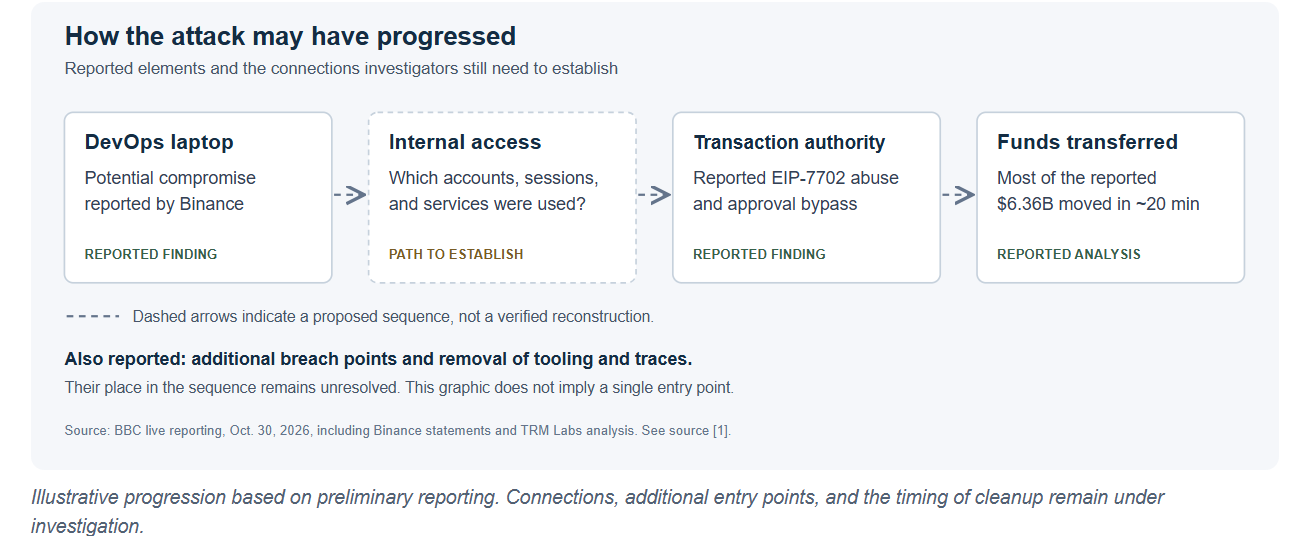
A compromised workstation is a starting point. Investigators must establish which accounts, sessions, and services were accessible from it, then determine which the attacker actually used. The reported discovery of additional breach points makes that distinction particularly relevant to this incident.
Endpoint records can reveal execution activity, browser artifacts, command history, and other evidence. Authentication and application logs can help establish subsequent access and requests. Investigators need to connect those records through timestamps and identifiers, then test whether the resulting sequence supports their explanation.
The findings determine how far the response needs to extend. Isolating a workstation may leave other access paths available if an attacker established separate sessions or compromised additional systems. A sound investigation identifies those possibilities and records which systems, accounts, and time periods have been examined.
The reported EIP-7702 involvement adds an authorization question to the endpoint investigation. The Ethereum specification describes a mechanism that allows an externally owned account to delegate code execution to another address. Establishing its precise role here requires a fuller technical account of how the relevant authority was obtained and exercised.
For enterprise investigators, the broader issue is the relationship between technical permission and intended approval. A system can accept an action without that action having followed the organization’s prescribed approval process. Investigators need to examine what authority existed, whether it changed, and how that state relates to activity on internal systems.
Different explanations require different evidence. Theft of a private key, misuse of a signing service, and abuse of another authorization path would have different implications for remediation. Transaction records establish movement of funds; endpoint, identity, and service evidence can help explain the access and actions behind it.
The reported transfer window describes the visible loss. Investigators also need to establish what happened beforehand: when suspicious access began, which privileges were available, and whether activity on other systems helped prepare the theft. Restricting the inquiry to the transfer period could exclude the events needed to explain it.
Building that timeline requires attention to differences among evidence sources. Endpoint, identity, application, and blockchain records may use different time conventions or record different stages of an action. Events close together in time deserve examination, but their relationship needs corroboration.
Once the immediate loss is contained, the organization still needs to establish which endpoints and identities remain affected. The reported additional breach points make that question especially important here. Restoring a service requires a supported assessment of the remaining access paths, alongside validation of the service and its authorization controls.
A useful starting point is the earliest confirmed compromised endpoint. Investigators can extract and validate indicators of compromise, including malicious file hashes and relevant detection rules, then search other accessible endpoints for related evidence. Persistence checks and examination for lateral movement help test whether the compromise extends beyond the initially identified device. A sweep should record its coverage, results, and blind spots; finding no matches does not certify that every device is clean.
Agentic AI can help organize that work. In the Windows endpoint workflow described by Exterro’s technical team, ARMOUR for FTK can use an investigator’s plain-language incident description to help build a forensic execution plan for review, with supported actions performed through ARMOUR for FTK. Investigators can use live inspection, targeted searches, and pre-flight previews to refine collection as findings emerge. AI assists with planning and orchestration; forensic examination and human review determine which indicators are meaningful and which findings support a decision.
Credential exposure needs its own examination. Cloud CLI configurations, kubeconfig files, SSH keys, environment files, browser session artifacts, and PowerShell history can help investigators identify credentials and services that warrant urgent review. Their presence on a compromised host does not prove theft, and endpoint evidence alone may not reveal every affected identity. Combined with identity and service logs, these findings can help responders prioritize revocation and rotation while applying broader precautions where uncertainty warrants them.
This is where faster forensic investigation can contribute to recovery: establishing additional endpoints of concern, identifying potentially exposed access, and preserving evidence that guides remediation. Endpoint findings must be considered alongside cloud, service, and transaction analysis before sensitive operations resume. The Windows workflow described here does not establish coverage of developer devices running other operating systems, and it does not independently validate the security of a withdrawal service.
Where operationally appropriate, investigators should preserve relevant memory before a system is reimaged. Memory can contain session material, network connection information, and evidence of running code that a rebuild would remove. Capturing it creates an opportunity for examination, rather than a guarantee that any particular token or implant will be recovered.
The reported destruction of tooling makes independently retained records especially important. Centralized authentication logs and service audit trails may preserve activity no longer visible on the affected device. Investigators need to identify those sources and their retention limits before relevant records disappear.
Deleted-file examination may also yield leads where recoverable data remains. Recovery depends on the storage system and subsequent activity, so teams should avoid assuming that removed tooling can be recovered. Collection priorities need to reflect the volatility and relevance of each source, coordinated with containment of active harm.
The response itself also needs a reliable record. Actions taken, their timing, and the people responsible should remain distinguishable from attacker activity. AI-assisted summaries must remain traceable to supporting evidence so investigators can verify findings and explain gaps.
Security leaders can turn these questions into a practical readiness exercise. Choose a privileged workstation, map the critical services and approval processes it can reach, and identify the evidence needed to reconstruct misuse at each step. Establish where that evidence resides, how long it survives, and who can preserve and examine it.
The eventual technical findings should explain the Binance attack in greater detail. Enterprise teams can use the incident now to test whether their evidence would establish the scope of a compromise and support a decision to restore sensitive services. That requires knowing what was examined, what was remediated, and which uncertainties remain.
Sources for publication
[1] BBC News, Binance live reporting, October 30, 2026. Relevant updates: 15:18, 15:31, and 15:42 GMT.
https://www.bbc.co.uk/news/live/cqrmynd3042gt
[2] Ethereum Improvement Proposals, EIP-7702: Set Code for EOAs.
https://eips.ethereum.org/EIPS/eip-7702