How Advanced Digital Forensics Software Can Crack Urgent Investigations Like the WHCA Assassination Attempt

In a digital forensics emergency, processing delay is an investigator's greatest liability. When a threat emerges, teams do not have days to parse unstructured data; they have hours. A look at a real-world national security operation handled by the FBI’s Washington Field Office demonstrates how modern forensic software architecture can cut through millions of digital artifacts under an unforgiving clock.
The Challenge: Reconstructing a Pathway to Violence
On April 25, 2026, at 8:36 p.m., the annual White House Correspondents’ Association Dinner at the Washington Hilton became an active crime scene. A 31-year-old suspect named Cole Tomas Allen bypassed a security magnetometer, heavily armed with a 12-gauge shotgun, a .38 caliber semi-automatic pistol, and multiple knives.
His target list included the highest levels of the U.S. administration: President Donald Trump, Vice President JD Vance, and senior cabinet members. Because Allen was unknown to intelligence agencies prior to his arrest and refused to cooperate, investigators had zero informant leads, no historic surveillance data, and no operational shortcuts. They had to understand his pathway to violence entirely from his digital footprint.
The data, including devices, cloud data sources, social media, financial and travel records, and more, spanned multiple jurisdictions:
- The Planning: A hotel reservation booked on April 6, followed by a multi-city train route stretching from Los Angeles to Chicago, and into Washington, D.C..
- The Intent: A physical manifesto ranking administration targets from highest to lowest , coupled with a pre-scheduled "apology" email broadcasted to family and a former employer minutes before the security breach.
- The Digital Footprint: Historic firearms transactions dating back to 2023 and 2025 , Hilton surveillance video metadata , and a suspended Bluesky social media profile operating under the handle "coldforce."
Federal prosecutors faced a tight deadline to file formal charges–but they met it, charging Allen with four crimes on Monday, April 27th, less than 48 hours after the incident.
Want the full story? Read the case study here.
Traditional, single-node processing used by many digital forensics solutions couldn’t meet the FBI’s need for speed. But the Exterro FTK Suite was designed and built to directly address these challenges. Several key features empower disparate teams to work together, faster than is possible with traditional digital forensics solutions.
Centralized Collaboration
Traditional forensic tools rely on single-node processing—meaning one workstation handles one piece of evidence at a time. When managing millions of artifacts under emergency conditions, this legacy architecture creates a massive bottleneck.
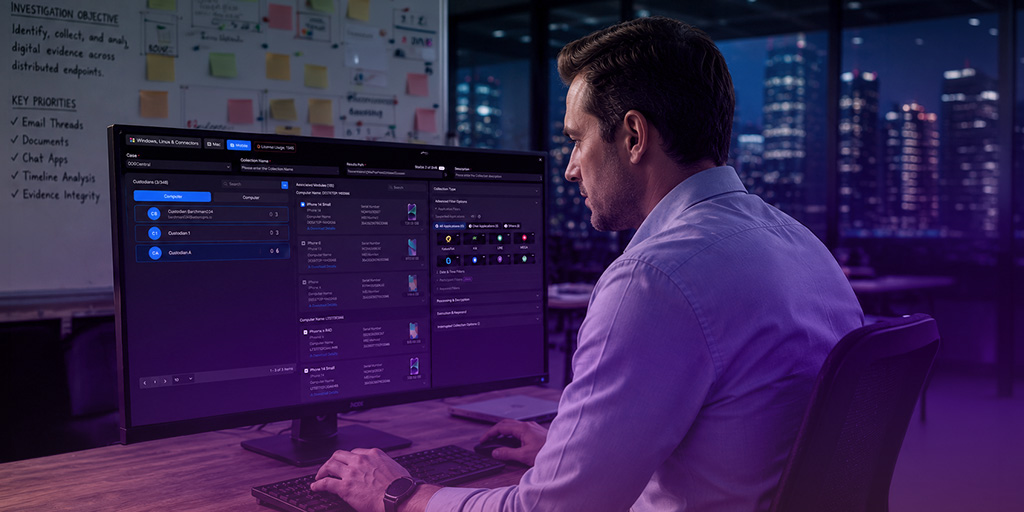
Exterro FTK Central uses a distributed processing engine. By breaking up the ingestion, indexing, and carving tasks across multiple server nodes simultaneously, processing scales horizontally. Industry benchmarks indicate this approach operates 10x to 20x faster than traditional setups–slashing timelines from days to hours, and allowing investigators to start analysis on the same shift as device seizure.
In a centralized enterprise tool like FTK Central, this architecture also allows teams to access evidence across a secure, web-accessible framework.
During the Allen investigation, different investigatory teams–the FBI CART team, the Behavioral Analysis Unit, the Secret Service, and federal prosecutors–all required immediate access to the same evidence. FTK's collaborative architecture enabled concurrent reviews. When an analyst annotated a financial log or tagged an artifact, that insight updated instantly across every team's view in real time, preventing the duplication of effort that frequently plagues multi-jurisdictional cases.
This capability yields rewards in private sector or corporate investigations as well. In an insider threat or ransomware incident, data silos cause operational paralysis. Corporate HR, risk compliance officers, internal security analysts, and outside legal counsel all need immediate access to system logs and communication histories. A centralized, web-based platform provides role-based access control, allowing external stakeholders to review data securely without generating conflicting data duplicates or breaking the chain of custody.
Agentic Digital Forensics and Human-Guided AI
Processing speed solves the ingestion problem, but the cognitive burden of reviewing millions of lines of data remains a human limitation. Enter the next major leap in DFIR technology: agentic AI for digital forensics. Rather than relying on classic keyword queries or rigid Boolean logic, Agentic AI introduces autonomous, specialized software entities designed to automate complex workflows and dynamically adapt to active case requirements under human supervision.
- The Orchestrator Agent: Automated systems ingest raw evidence, determine file structures, and automatically map out execution paths without manual human scripting.
- The Analysis Agent: This agent handles deep semantic mapping. It goes past standard keyword match queries to scan unstructured text, recognize criminal intent, and immediately link that concept to specific physical coordinates derived from cross-country travel metadata or financial purchase timelines.
- The Validation Agent: For enterprise governance and courtroom presentation, compliance is non-negotiable. Every insight generated by an assistant must point directly back to an unaltered, cryptographically hashed source file to maintain an unbroken, auditable chain of custody.
Working in tandem with skilled investigators, this agentic approach shifts digital forensics from a reactive search process to proactive asset synthesis. Instead of forcing an analyst to manually reconcile mismatched timestamps across multiple device extractions, the AI automatically aggregates disparate data points—a weapon purchase receipt, a train ticket geolocation log, and a draft email—into a single, fluid chronological narrative. It instantly visualizes the suspect's momentum, flagging critical escalation points so the human team can grasp the entire "pathway to violence" at a glance.
This intelligent timeline generation serves a vital operational purpose: it guides investigators to the smoking guns first. By automatically identifying and bubbling up high-value signals—like a prioritized target list buried inside a sea of unallocated space—the AI ensures that precious, early operational hours are spent building the case rather than digging through noise. This targeted triage significantly reduces the cognitive burden on the team when the clock is ticking and failure is not an option.
Purpose-Built for Security, Privacy, and Defensibility
To deploy this level of automation safely in enterprise or federal spaces, Exterro FTK uses security design principles that ensure data security and integrity.
- Zero Model Training on Case Data: AI systems must never use sensitive case evidence or corporate IP to train public or proprietary models.
- Private Perimeter Isolation: The analytical engine must live entirely within the user's localized security perimeter (on-premises or private virtual cloud) to prevent external data leaks.
- Auditability Over Buzzwords: Every automated action must be fully logged, ensuring all forensic findings are defensible under aggressive cross-examination.
Whether protecting the executive branch or defending an enterprise network from an active breach, the fundamental requirement remains the same: clarity under pressure. Centralizing collaboration and leaning into verified, secure automation allows digital forensics teams to replace data chaos with definitive, court-ready truth.
Learn more about how Exterro FTK can support your digital forensics investigations.