Trust Matters More Than Speed for AI in Legal, Regulatory, and Compliance Workflows
Artificial intelligence is advancing faster than most organizations can keep up with. Vendors promise efficiency gains, cost savings, and accelerated insights. Yet for legal, compliance, and investigative teams, AI cannot simply be about speed. It must be about trust.
When the outcome of a workflow may be presented to a regulator, relied upon in court, or used to defend against allegations of misconduct, the AI generating those outputs must not only be powerful—it must be transparent, auditable, and controllable. Without those foundations, AI introduces more risk than it removes.
In many industries, a small error or a missed citation may be tolerable. In legal and compliance, it can unravel an entire case or undermine a regulatory submission. Speed is meaningless if the result cannot stand up to scrutiny.
The EU AI Act, new U.S. executive orders, and evolving global privacy frameworks are making this reality clearer by the day: AI must be deployed in a way that is defensible. That means systems cannot be black boxes. They must allow teams to verify where answers come from, understand how those answers were derived, and maintain accountability for the final judgment.
This is why the real differentiator in enterprise AI isn’t performance benchmarks—it’s trust. And trust can only be built on three pillars: transparency, auditability, and control.
Transparency: Show Your Work
Transparency is the antidote to AI “hallucinations.” General-purpose generative models are designed to produce text that looks plausible, not necessarily correct. In consumer use cases, that may be acceptable. But in regulated environments, fabrications aren’t just unhelpful—they’re potentially catastrophic.
True transparency means an AI system shows its work at every step. Outputs should come with references, citations, or logs that prove the underlying data. If an AI flags a document as privileged, the reviewer must see the basis for that classification. If it produces a timeline of events, every entry must be traceable back to source material.
This level of visibility doesn’t just reduce risk—it builds confidence. Teams can move faster knowing they can always trace back to the facts. Regulators and courts are more likely to accept AI-enabled outputs when the methods are clear and verifiable. Transparency turns AI from a liability into a partner.
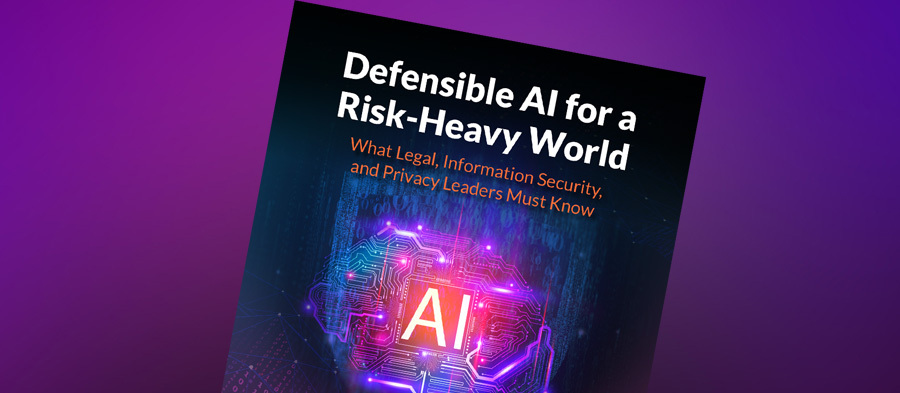
Want to dig deeper into the why behind Exterro Intelligence? Download our whitepaper, Defensible AI for a Risk-Heavy World.
Auditability: Every Action Accounted For
Auditability extends transparency into the full lifecycle of AI-assisted work. It’s not enough to see what data was surfaced—you also need to know how, when, and by whom.
In legal review or compliance reporting, every step matters: who initiated a search, which agents were applied, what exceptions were raised, and when a human approved or rejected a result. Without this, organizations face an evidentiary gap. Regulators expect logs that show decision-making processes. Courts expect litigants to explain how evidence was identified or excluded.
A defensible AI system therefore must capture every action, agent decision, and human intervention in real time. These logs create a reproducible chain of custody for digital decisions. They allow organizations to go back months later and demonstrate not only what conclusions were reached, but also how they were reached.
Auditability doesn’t slow workflows—it strengthens them. When your processes are logged and verifiable, you can respond to audits and challenges with confidence, instead of scrambling to recreate a trail after the fact.
Control: Keeping Humans in Charge
Perhaps the most critical pillar of trustworthy AI is control. In legal and compliance work, human oversight is not optional. AI can accelerate analysis, highlight risks, and process vast amounts of data, but it must never displace expert judgment.
Control means several things in practice:
- Data control – AI should operate within the organization’s environment, not send sensitive data to third parties for processing.
- Operational control – Reviewers must be able to accept, reject, or modify AI outputs, ensuring ultimate accountability remains with the human decision-maker.
- Policy control – The system must enforce organizational rules and regulatory obligations, from privilege review to jurisdictional redaction standards.
Without these safeguards, organizations risk overreliance on automation. With them, they gain the best of both worlds: AI handles the repetitive, high-volume tasks, while humans focus on strategy, judgment, and defensibility.
Trust as a Competitive Advantage
There’s a tendency to see compliance requirements as boxes to check. But in the case of AI, building trust through transparency, auditability, and control is not just about avoiding penalties—it’s a source of competitive advantage.
Organizations that can harness AI responsibly move faster with confidence. They don’t lose time second-guessing results. They don’t risk costly re-reviews. And when challenged, they can prove their process, instead of defending a black box.
Competitors who rush into AI adoption without these foundations may find themselves backpedaling—redoing work, dealing with regulator skepticism, or defending indefensible processes in litigation. Those who prioritize trust from the start gain not only defensibility but also credibility in the market.
Exterro’s Commitment
At Exterro, these principles aren’t marketing slogans. They are the foundation of Exterro Intelligence. Every agent is purpose-built with clear scope. Every output comes with citations. Every decision is logged. And every deployment ensures customer data stays within the customer’s controlled environment.
By embedding transparency, auditability, and control into the architecture, Exterro makes AI safe to use in the most demanding legal and compliance environments. It’s not AI for speed alone—it’s AI you can trust when the stakes are highest.
The AI conversation in legal and compliance can’t stop at performance. Speed without trust creates risk. Trustworthy AI is built on transparency, auditability, and control—pillars that make automation not only defensible but empowering.
Organizations that adopt AI responsibly today will be the ones best prepared for tomorrow’s regulatory scrutiny and competitive challenges. With Exterro, trust isn’t an afterthought. It’s the system.