The Human Side of Readiness: Coaching Legal, IT, and Security Teams for Litigation Success
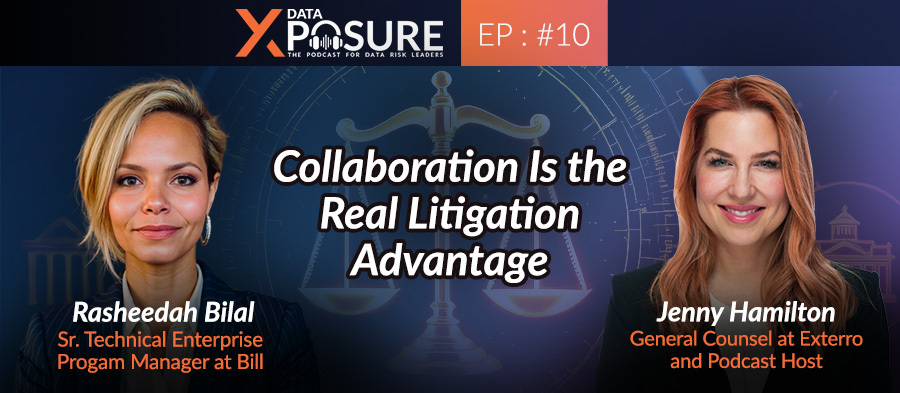
The Human Side of Readiness: Coaching Legal, IT, and Security Teams for Litigation Success
Host: Jenny Hamilton, Chief Legal Officer, Exterro
Guest: Rasheedah Bilal, senior litigation and eDiscovery leader, Bill
In this episode of Data Xposure, host Jenny Hamilton sits down with Rasheedah Bilal, a senior litigation and eDiscovery leader at Bill.com, to explore an often-overlooked factor in litigation readiness: your team’s ability to execute under pressure, with the resources and people you already have.
Drawing from Rasheedah’s journey from the military to the classroom to the corporate legal world, this conversation dives deep into what it really means to be "ready." It’s not about chasing the perfect resourcing model, it’s about coaching people toward their strengths, bridging gaps across departments, and leading with trust, especially when expectations don’t match reality.
Jenny and Rasheedah unpack how misaligned roles, unclear responsibilities, and rigid expectations can stall progress in high-stakes matters, and what leaders can do to build cross-functional muscle memory between legal, IT, and security.
Because at the end of the day, litigation success isn’t just about tools or processes. It’s about people and how well they work together when it counts.
Subscribe on Your Preferred Podcast Platform
Apple Podcasts | Spotify | YouTube
Episode Transcript
Jenny (01:14.815) Litigation today doesn't fail because teams don't care; it fails because they're not aligned. I'm Jenny Hamilton, and this is Data Exposure, a podcast brought to you by Exterro, a leader in data risk management software. On this show, we're going to unpack how daily risk shows up when strategies, systems, and people collide.
Today, we're talking about the human side of intelligence, litigation, and eDiscovery. Specifically, why collaboration and soft skills—which I like to call "hard skills"—are often the deciding factor between chaos and control. I'm joined (and very excited to have her) by Rasheedah Bilal from Bill.com, who brings deep real-world experience working across legal, IT, and security teams in high-pressure environments. We're going to dig in today about what actually breaks down during litigation, how legal teams can effectively engage technical stakeholders better and earlier in the process, and why influence, not authority, is becoming a critical skill for modern eDiscovery leaders. Let's get into it.
Rasheedah, thank you for joining me today.
Rasheedah Bilal (02:35.032) Thank you, Jenny. Thanks for having me on here. I'm excited.
Jenny (02:39.166) You have such an interesting background. I don't know if you realized at the time how your career journey was going to benefit you today, but I want to talk a little bit about that. You've worked in the military and education, and you now work in a corporate IT environment. What about these worlds taught you something about people that surprised you?
Rasheedah Bilal (03:15.192) You know, I don't know if I would say that it surprised me so much as it probably set me up. I grew up in a household of teachers—both my parents were professors and educators. I remember my first time teaching a class and my dad imparted wisdom to me about setting the tone for the entire team, all of my students.
I didn't realize it at the time, but it really was about establishing trust and being able to "read the room"—read these little humans, read my team. We were going to succeed at the end of the school year together, but it was about setting conditions so that they could trust me. That allowed me to easily pick up if someone wasn't feeling well.
That led me into my military career. No one saw the switch from a second and fifth-grade teacher to the military coming—I don't think even I saw that coming! I actually went to a recruiter's office to help a friend and the next thing I knew, I was joining. But 16 years of serving, first enlisted and then as an officer, taught me that the greatest thing I've ever learned is how to manage people—your ability to manage personalities.
I say great leaders can manage personalities. Readiness from a people perspective is not necessarily about how well-resourced you are, but how well you can motivate the team that you have. In the military, there is a saying: "You go to war with the team you have, not the team you want." Oftentimes, you could wish for perfect conditions—the right IT partner, the right security partner, the perfect legal leader—but it’s never how that works. Then you add in personalities, skill gaps, expectations, and communication skills.
I liked that you said these are "hard skills." They are extremely hard skills—to show up, be nuanced, and understand that people's behavior is often tertiary. If you know your teams and someone shows up with their hair in disarray, and you’re observant, you’d know that’s probably an indication of something in their life taking them away. That could affect their work quality. It takes a lot to manage that—noticing people and getting to know them.
As a leader, your job is to motivate people to reach their potential while recognizing that not every paralegal or engineer is the same. How do you manage that to have a cohesive team? Sometimes people don't know what "team" they're on. If I’m a leader, I manage my direct reports, but my "team" also includes the technical partners, the engineer partners, and the security partners I need to collaborate with. It’s important to manage those relationships across, not just down.
Jenny (07:13.826) That leads us into your current career in a corporate IT department, collaborating with legal. How did you get there? I want to understand how you got from the military into corporate IT.
Rasheedah Bilal (07:48.95) I got there through someone recognizing my talent and saying, "I think you have the capacity to learn a new industry." Those people skills—being able to understand strategy—were key. My job at the time was as a strategic planner for our unit. I was responsible for developing plans for anywhere between the next 72 hours and the next year.
There were a lot of moving pieces. Putting the plan together didn't mean I knew all the logistics, security, or IT needs. It was about recognizing where I wasn't the SME (Subject Matter Expert). If we were deciding on an operation, it was about recognizing, "Okay, we don't have the logistics partner in here." You need logistics to ensure a realistic timeline and legal to ensure we are good with the plan.
That translates to the business world. Legal might be the business partner wanting to implement technology. My job is to recognize if a timeline is realistic. Does it require code? Does it require security reviews? I help them understand what "go-live" really means and if we can break it into a phased approach. When people have an "ask," they shouldn't get stuck in the solutioning. Describe your problem, but let the experts solution it.
I imagine it works the same for legal teams. Other business partners want to get a contract through and may think they know better than their in-house counsel, so they get stuck "solutioning" instead of defining the business parameters they need.
Jenny (10:40.962) I'm laughing because, in a former life, I worked for a manufacturing house. The attorney before me had been a diesel mechanic and an engineer before becoming an attorney. He could get in there with the engineers on a product safety question and "solution" away. I felt like I couldn't bring that expertise, but over the years, I saw that it actually gets in the way. When I worked with patent lawyers who wanted to re-engineer the litigation process, I’d have to say, "Time out, no more engineering and solutioning."
Rasheedah Bilal (11:35.863) It's human nature. The more of an SME you become in your area, the easier it is to confuse your intellect in that one area and assume you're an expert in every other field. If we all took a pause, we could find a story where we tried to step into someone else’s lane—be it a doctor or a mechanic.
That’s what got me into corporate IT. I actually came in on the legal operations side. The project management part came easy, but the application of the "hard skills" was figuring out who my teammates were. Meeting them as people takes time—it’s scheduling that 5 p.m. cocktail hour or cross-functional outreach to get to know them.
Learning the legal and technology worlds was fast and furious. I proactively scheduled time with mentors to learn about patents, eDiscovery, litigation, and employment matters. I remember on one call, they kept saying the word "API," and I thought, "My gosh, I don't know what API is!" My boss says now he would never know I’ve only been in the legal corporate world for five or six years. I credit that to having practiced those "harder" skills over the last 20 years.
It’s not authority, because I don't have much of it—it's influence. It's genuine care, trust, and using those relationships to influence. If you don't know your teams, under stress, people revert to old habits. If you know those teammates upfront, you can introduce processes more easily.
Jenny (16:20.354) I want to go back to the "tertiary effect" you mentioned. Where did that come from, and how do you see it playing out in your role?
Rasheedah Bilal (16:36.974) From a psychology perspective, most of us aren't taught how to communicate issues. Often, we communicate via a tertiary effect. People see anger, but anger is usually a secondary emotion—a protective response to stress, sadness, grief, or fear. The tertiary is the behavior.
It’s someone lashing out at work who is normally reserved, or someone not showing up for two days, or someone normally put-together coming in disheveled. Those behaviors are often indications of something behind the scenes.
I had a soldier once who went AWOL (Absent Without Leave). His supervisors wanted to go the punitive route immediately. I asked, "Has he ever done this before? Is there anything going on in his life?" I reached out and told him, "What you did wasn't professional, but I want to make sure you're safe. Take the day off, and tomorrow, just come in for a conversation. You don't even have to be in uniform."
He showed up and broke down crying. He was young, his wife was moving away for active duty, he had no family nearby, and the military hadn't processed a bonus he was entitled to because he couldn't take a PT test due to an injury. His life was falling apart, and all we saw was a burst of anger. We had failed him as leaders because none of us knew this had been going on for two years.
In high-stress corporate environments, you might see this in an unprofessional email. It's easy to take offense, but it’s more strategic to pull them aside and say, "Hey, what's going on? You don't normally talk like that." It allows you to practice grace or set a boundary without it turning into a "thing."
Jenny (22:11.393) You seem to draw on a lot of psychology. How did you weave that into your leadership style?
Rasheedah Bilal (22:28.178) Behavioral psychology is my favorite area of expertise. Since I was a kid, people have been drawn to share things with me. I learned early on how to "hold space" for people. Humans are extremely complex. I find joy in helping people be comfortable in their work.
If people are comfortable, it's easier to get to the root of the problem. There’s a saying: "If you can articulate the problem correctly, you've solved 50% of it." Often, people try to solve symptoms instead of doing a root-cause analysis.
This ties into litigation and eDiscovery—the philosophy of people, process, and platforms. Oftentimes, people interject themselves into a process just to feel they have control. But if a process can stand the test of time regardless of who is in the position, you avoid bottlenecks.
Jenny (27:32.738) You mentioned the "domain of risk." Tell us why that’s important.
Rasheedah Bilal (27:51.063) The person whose domain of risk it is needs to be the decision-maker. As a leader, you can’t delegate risk. Conversely, if it’s not your risk to assume and you insert yourself, you’re just bottlenecking the system. Sometimes people insert themselves for a need for control.
Jenny (29:32.386) You also said people sometimes need to be "protected from themselves." How does that come up?
Rasheedah Bilal (29:58.657) If you're an expert in litigation, it doesn't mean you're an expert in technology. Protecting people from themselves means limiting their access to their specific scope. When implementing eDiscovery tools like Exterro, it was pertinent to ensure attorneys didn't have the same admin rights as paralegals. Attorneys aren't in the system enough; they might accidentally break templates or run things they shouldn't in an audited program.
I’ve seen attorneys break systems by assuming the role of the eDiscovery person. If that’s not your role, why are you in there playing around?
Jenny (33:36.298) Litigators are the worst attorneys to work with in this regard! Because their job is to come up to speed quickly on complex matters, they want to jump in and don't recognize the boundaries of their expertise. It makes conversations take so much longer and can derail the process. I had better luck with non-litigators who understood they didn't know the tech and let the best practices guide them.
Rasheedah Bilal (35:31.503) That comes under managing personalities. If I know someone doesn't receive feedback well, I just manage their scope. I once had someone ask, "Are you managing me?" and I said, "Yes, I am."
Jenny (36:03.618) Did that start with your teaching job? Knowing you can't talk to one child the same as another?
Rasheedah Bilal (36:20.852) Absolutely. In a classroom of 20, no two students are motivated the same way. I had one student, Hasnaa, who was very strong-willed. It wasn't about disciplining her; it was about getting her excited. If I told her I needed help with a task, she felt a sense of pride. I gave her responsibilities like collecting workbooks or helping with artwork.
Other students were shy, so I had to switch up activities. I did "quiet whispering hours" where they’d close their eyes and tell a story so they didn't have to be "seen" by anyone else.
Jenny (38:47.138) That would be helpful in the workplace too! Your approach starts with acceptance. You're accepting the behavior isn't the root cause. What are some of your favorite books you’d recommend?
Rasheedah Bilal (39:54.882) One is Conversational Intelligence by Judith Glaser. Another is We Should Get Together by Kat Vellos. There’s also Tribe: On Homecoming and Belonging by Sebastian Junger.
In the military, I taught my lieutenants to "fail fast, fail forward." I wanted them to try things outside their comfort zone while I provided invisible guardrails so they wouldn't assume risk outside their scope. Failure wasn't the end of the world as long as no one was hurt and no laws were broken. Then, I’d make them write an SOP (Standard Operating Procedure) on how they fixed it.
Jenny (41:49.654) Attorneys are very afraid to fail! That's where the friction between Legal and IT comes from.
Rasheedah Bilal (44:49.07) The simplest example of conversational intelligence: Have you ever had a boss text you late Friday saying, "We need to talk Monday morning"? That doesn't set up the brain chemistry for trust.
I had a boss who would call and say, "How’s your weekend looking? Great. Listen, I have an idea I want to discuss, but I don't want to bother you over the weekend. Come see me Monday—it’s nothing bad, I just don't want to forget the idea." That took two extra minutes but ensured I wasn't a nervous wreck all weekend.
Jenny (47:15.542) Especially when influencing without authority, you need people to show up from a place of trust.
Rasheedah Bilal (47:59.811) One last story: A new manager was trying to get something done with IT, and they told him "too bad, it’s a six-week process." He asked me for help. I walked down, brought a cupcake, saw an old friend, and said, "Listen, we've got a new guy who doesn't know the process, but we’re really behind. Would you do me a solid and take care of this?" It got done in 48 hours.
The skill there is relationship building. People say they don't like "small talk," but small talk builds the capacity for grace. If I know you went on a trip to Japan or like cats, I’m endeared to you. Then, when we have a hard conversation, I can start with positivity. Another trick I like to use is making myself the problem: "I feel like I’m failing you. How can I best support you?" It stops them from being standoffish and keeps the temperature down so we can solve the problem.
Jenny (51:53.888) You have to bring the temperature down for that. Rasheedah, this has been amazing. Strong litigation and eDiscovery outcomes aren't just about the tech—it's the people.
Huge thanks to you for an honest conversation about what really matters. Data Exposure is brought to you by Exterro. If this episode resonated, please subscribe on YouTube or wherever you get your podcasts. I’m Jenny Hamilton, thank you for listening. We’ll see you next time on Data Exposure, where strategy meets consequence.
(Post-show banter)
Jenny (54:14.914) We always make Mike nervous about the time!
Rasheedah Bilal (54:54.094) I felt like we could have talked forever.
Jenny (54:59.202) I know! We need to do a part two. Stay in touch, I still have to finish these books. Let’s talk soon!
Rasheedah Bilal (56:18.958) Okay, bye guys!