The Hard Truth: GenAI Isn’t Built for Legal, Privacy, or Compliance Workflows
Generative AI has been hailed as a breakthrough technology for knowledge work. In the last two years, systems like GPT-4, Claude, and Gemini have shown that they can draft emails, summarize documents, and even mimic legal reasoning in ways that seemed impossible a decade ago. For many industries, that’s more than enough. For legal, privacy, and compliance professionals, though, the story is very different.
These domains do not operate on “good enough.” They are governed by rules of evidence, regulatory frameworks, and professional obligations that demand precision, transparency, and defensibility. And this is exactly where GenAI, for all its promise, begins to unravel.
The Problem with Black Boxes
At the core of large language models lies a simple truth: they were not designed for environments where accountability matters. LLMs generate text by predicting the most statistically likely sequence of words, not by reasoning or citing evidence. Their outputs may read with confidence, but beneath the surface they are opaque, non-deterministic, and impossible to audit.
That’s not a problem if you’re writing marketing copy or brainstorming creative ideas. It becomes a critical flaw when the output is a contract summary, a breach notification, or a privilege determination. In these contexts, professionals must be able to explain not only what a conclusion is, but why it was reached. A machine that can’t show its work is worse than useless—it’s a liability.
When “Close Enough” Becomes Catastrophic
The risks of applying GenAI in sensitive environments are not theoretical. Courts, regulators, and enterprises have already seen how badly things can go when black-box systems are trusted in the wrong context.
Consider Mata v. Avianca in 2023, where a New York law firm filed briefs that included entirely fabricated case citations generated by ChatGPT. The court imposed sanctions, underscoring the principle that legal work must be verifiable. Or take Amazon’s abandoned AI recruiting tool, which learned bias from historical data and penalized female applicants. Uber’s “Greyball” program went even further, deliberately disguising rides from regulators to evade oversight. Clearview AI, the facial recognition company, has been fined over €70 million in Europe for scraping biometric data without consent.
In each of these cases, the problem wasn’t simply that AI made mistakes—it was that those mistakes were hidden behind systems that offered no transparency, no explainability, and no accountability. In high-stakes workflows, “hallucinations” aren’t amusing—they are disqualifying.
The Compliance Gap
Even if GenAI could be made more accurate, it still collides with another immovable barrier: compliance. Most large language models require sending data to cloud-based APIs run by third-party vendors. That might be acceptable for everyday business content, but it directly conflicts with the obligations of lawyers, privacy officers, and security professionals.
Data sovereignty laws like the GDPR and the California Privacy Rights Act restrict how personal information can be stored, transferred, and processed. Industry frameworks such as HIPAA for healthcare or CJIS for criminal justice require strict controls over access and storage. And the core ethical duty of attorneys—to preserve confidentiality and privilege—cannot be reconciled with routing sensitive case material through opaque, third-party servers.
These compliance obligations are not nuisances to be engineered around. They are bedrock requirements of operating in regulated domains. Any AI system that disregards them cannot be trusted, no matter how sophisticated its outputs appear.
What Defensible AI Must Look Like
If GenAI isn’t the answer, what is? The emerging consensus is that regulated environments need AI systems built on different principles altogether. They must be able to explain their outputs, maintain auditable records, and operate entirely within the enterprise boundary. They must be procedural, not probabilistic—capable of executing multi-step tasks in ways that mirror the logic and oversight of human experts.
This is the promise of agentic AI. Unlike GenAI, which waits for a prompt and spits out a response, agentic systems pursue goals, decompose them into subtasks, validate intermediate results, and escalate to humans when decisions are ambiguous. Every action is logged, every path traceable. Instead of being a black box, the system becomes a glass box: transparent, reviewable, defensible.
Exterro has taken this principle to heart. With Exterro Intelligence and Exterro Assist for Data, we’re building AI designed for legal, privacy, forensic, and compliance workflows from the ground up. Every agent operates inside customer infrastructure—no data leaks, no hidden APIs. Every action is logged for audit and defensibility. And humans remain in the loop, empowered to oversee, approve, or correct AI-driven actions. In other words, it’s AI that meets the bar regulators, courts, and clients already demand.
Drawing the Line
None of this means that GenAI has no role in the enterprise. It can be a powerful tool for many tasks—drafting a first-pass summary, suggesting edits, or assisting with knowledge management. But to imagine that the same system can handle evidence review, compliance reporting, or breach response is to fundamentally misunderstand both the technology and the stakes.
The lesson is clear: AI that dazzles in consumer or creative applications is not automatically fit for the courtroom, the regulator’s office, or the incident response war room. These environments demand AI that is not only intelligent, but also accountable.
The Hard Truth
Generative AI is a breakthrough, but it is not a panacea. In risk-heavy domains, its flaws aren’t just inconvenient—they are unacceptable. The future of AI in legal, privacy, and compliance won’t be built on clever chatbots. It will be shaped by systems that embrace transparency, defensibility, and governance as first principles.
That’s the foundation Exterro is building today. With agentic, audit-ready AI at the core of our Data Risk Management Platform, we’re delivering the kind of intelligence organizations can actually trust—because when risk is high, nothing less will do.
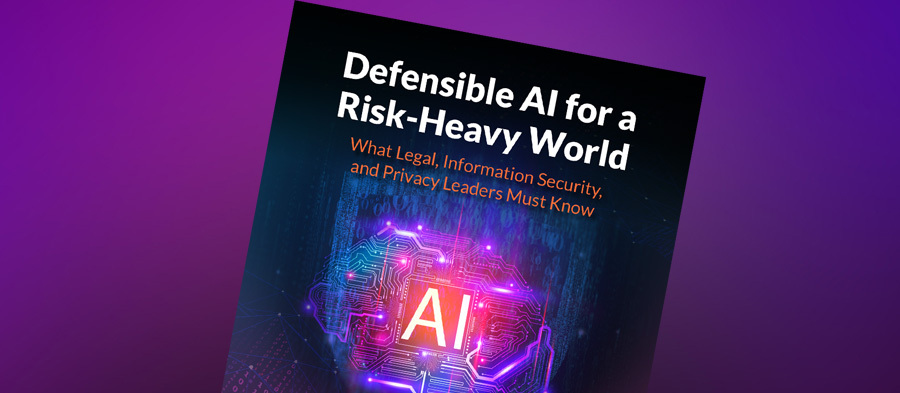
Get the full picture with our new whitepaper, Defensible AI for a Risk-Heavy World.