The Call is Coming from Inside the House: Why Operations, Not Regulation, Is the Real Threat to eDiscovery
There’s a classic scene in horror movies that almost everyone knows and recognizes. The heroine–probably a teenaged babysitter–is alone in the house. A phone call shatters the silence and we feel a sense of dread. She picks up the phone nervously, and DAH-DAH-DAH!
It’s the villain who’s been terrorizing her for the previous hour to hour and a half of screen time. The call is coming from inside the house!
For modern in-house legal teams, the 2026 eDiscovery landscape feels eerily similar. While many organizations have spent years looking over their shoulders at external threats like shifting regulations and judicial pivots, new research from Exterro reveals that the true danger to legal defensibility is already inside the enterprise. It isn't a lack of rules or "regulatory uncertainty" that is jeopardizing cases; it is a ghost in the machine of internal operations, where fragmented data, budget constraints, and a lack of cross-functional alignment are creating risks that no courtroom argument can fix.
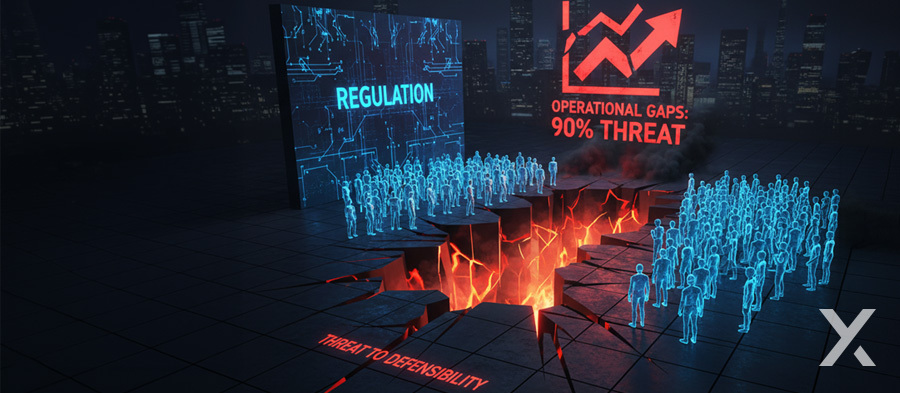
In multiple recent surveys of 400 IT, legal, data governance, and security professionals, we reached a surprising conclusion. Nearly 90% of legal and tech pros now say that internal operational gaps, rather than regulatory uncertainty, are what truly jeopardize a defensible eDiscovery process.
The Execution Gap: Why "Knowing the Rules" Isn't Enough
While the legal industry has spent decades mastering the theory of eDiscovery, the practical execution is hitting a wall. Only 10% of practitioners are currently worried about regulatory uncertainty. Instead, the "big three" barriers to success are purely operational:
- Budget constraints (37.8%)
- Limited internal expertise (28.9%)
- Lack of centralized data governance (23.3%)
Defensibility is no longer lost in the courtroom; it is lost "upstream" in fragmented data environments and inconsistent preservation. If your organization can't find or preserve the data correctly, the strongest legal argument in the world won't save you.
The AI Paradox: Acceleration Without Alignment
The surveys also reveals a startling speed of adoption: 47% of teams are already using AI in their discovery workflows, and nearly 80% are either using it or preparing to adopt it.
However, there is a catch. While teams are rushing to automate, the foundational literacy isn't keeping pace. For instance, while 80% of professionals feel confident talking about Data Privacy, only 62% are familiar with the actual mechanics of eDiscovery. This creates a "black box" risk where teams are using powerful AI tools without fully understanding the underlying data risks they are meant to manage.
The New Defensibility Requirement: Legal + IT Alignment
If operational readiness is the problem, cross-functional communication is the only cure. An overwhelming 97% of respondents agreed that communication between Legal and IT directly impacts the speed and defensibility of eDiscovery.
Despite this universal agreement, the reality on the ground is messy:
- 35% of teams rate their current Legal-IT collaboration as merely "fair" or "poor".
- The top hurdle? A lack of shared processes or documentation (40.2%).
Looking Toward 2026: Governance as the Foundation
As we look toward the rest of the year, the industry is reaching a consensus: AI and Data Governance together will define the next era of eDiscovery strategy. These two priorities account for nearly 60% of what will influence strategy in 2026.
The takeaway for in-house teams is simple: You cannot automate what you haven't governed. To remain defensible, organizations must stop viewing discovery as a reactive legal task and start treating it as a proactive, structural discipline.
For more insight, check out the press release on the survey today.