Reimagining the Legal Function with AI: Why Prompting May Be the New Drafting
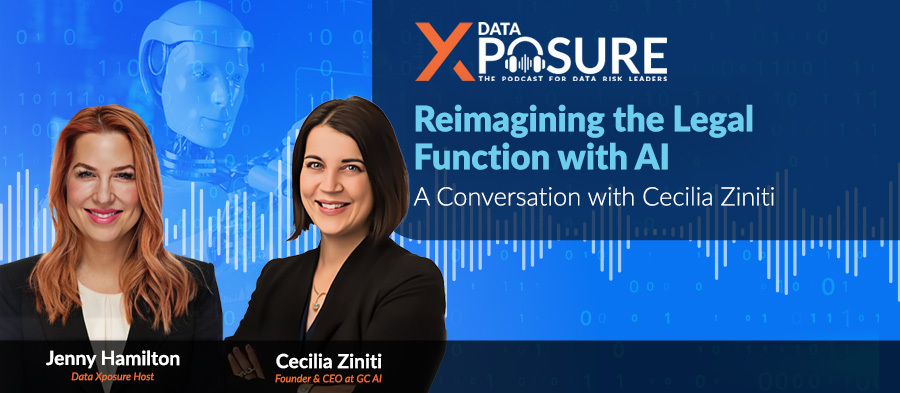
By Exterro | Featuring insights from Jenny Hamilton and Cecilia Ziniti, CEO & Co-Founder of GC AI
2025 isn’t the year AI “arrives” in legal—it’s the year it becomes unavoidable. From drafting contracts to shaping compliance strategies, generative AI is no longer a side experiment. It’s sitting at the decision-making table. For legal leaders inside global enterprises, the question is no longer if AI will change their function, but how fast they can adapt.
That’s the premise behind the very first episode of Data Xposure, where Exterro’s Chief Legal Officer, Jenny Hamilton, sat down with Cecilia Ziniti—CEO and co-founder of GC AI, three-time General Counsel, and former legal leader at Amazon, Cruise, and Cloudflare—to talk about what an AI-integrated legal function really looks like.
The conversation was equal parts candid and urgent. It was also a call to arms for legal professionals: if we don’t shape AI for legal, someone else will.
From “Crappy Device” to Career-Defining Moment
Ziniti’s AI journey didn’t start in a startup pitch room. It began in 2013, when she was handed a project no one else wanted at Amazon—a “broken” device called Doppler. That device became Alexa.
“It turned out to be the career move of a lifetime,” she recalls. “The privacy issues, the IP questions—it was all a preview of what we see today. That was the moment I realized AI wasn’t just a curiosity. It was going to be everywhere.”
It’s a lesson for today’s GCs: the technology that feels messy, uncertain, or even unwelcome is often the one that rewrites the future of your role.
The Transferable Skills of Tomorrow’s Legal Leaders
Ziniti believes that core lawyer skills—research, communication, empathy—are more valuable than ever in an AI-driven world. But to thrive, legal leaders will need more than black-letter expertise.
“Prompting is the new drafting,” Ziniti argues. “Directing AI effectively is becoming just as critical as writing the perfect clause. If you can’t guide the technology, you won’t be able to harness its value.”
She also urges attorneys to step outside traditional guardrails: “The legal skills are table stakes. If you want your career to soar, pick up other skills—business development, product strategy, even teaching. Those are what make you indispensable.”
Regulation: A Moving Target
With AI already embedded in sensitive workflows, regulation is inevitable. Ziniti compares AI’s trajectory to privacy law a decade ago—an “unwritten” but very real set of guardrails enterprises had to anticipate.
Her advice? Build compliance into products and processes before regulators catch up. “Clear rules are better than no rules,” she notes. “But waiting for regulators to spell out every scenario is a mistake. Companies that lead with thoughtful, customer-obsessed compliance will move faster and build trust.”
Building Trust in the Age of Data Anxiety
Perhaps the most resonant theme of the conversation was trust—both within organizations and with customers. Ziniti shared an example of her own startup, GC AI, navigating a potential (but contained) data exposure. Instead of delaying communication, her team notified affected customers immediately. The result wasn’t panic—it was confidence.
“That ability to provide clear, empathetic counsel under pressure is what distinguishes strong legal teams,” Hamilton added. “It’s not about saying no. It’s about unlocking the path forward responsibly.”
What the AI-Enabled Legal Team of the Future Looks Like
Ziniti envisions tomorrow’s legal teams as smaller, closer to the business, and infinitely more strategic. AI will take on the first draft of contracts, memos, and analyses, while attorneys focus on judgment, strategy, and human connection.
“Think of it like QuickBooks,” she said. “Everyone uses it, but CPAs still play a critical role. In the same way, AI will become the interface to legal work, but lawyers will still be essential—especially when stakes are high.”
Soft skills will be the new differentiator. “It’s not about being a better lawyer on paper. It’s about being a better people person. Client empathy, real-world connections, the ability to guide—not just block. That’s what will define great GCs in the AI era.”
Key Takeaways for Legal and Data Risk Leaders
- Prompting is the new drafting. Learn how to guide AI tools with precision—it’s becoming a fundamental legal skill.
- Don’t wait for regulation. Build compliance into your processes now. Customer trust is won through foresight, not reaction.
- Trust is the differentiator. Transparent, empathetic communication during moments of risk builds lasting credibility.
- Expand beyond law. The best legal leaders will be business partners, educators, and strategists—not just lawyers.
Why It Matters
Generative AI isn’t just another tool for legal teams. It’s reshaping the profession itself—what it means to practice law, to advise a business, to lead.
For those willing to adapt, it’s an opportunity to redefine the role of legal in business transformation. For those who hesitate, it’s a risk of irrelevance.
As Ziniti put it: “If you’re not using AI, the conversation will always feel theoretical. The only way to lead is to engage—and to bring your judgment, empathy, and creativity to the table.”
Listen to the full conversation with Jenny Hamilton and Cecilia Ziniti on Data Xposure, Episode 1.