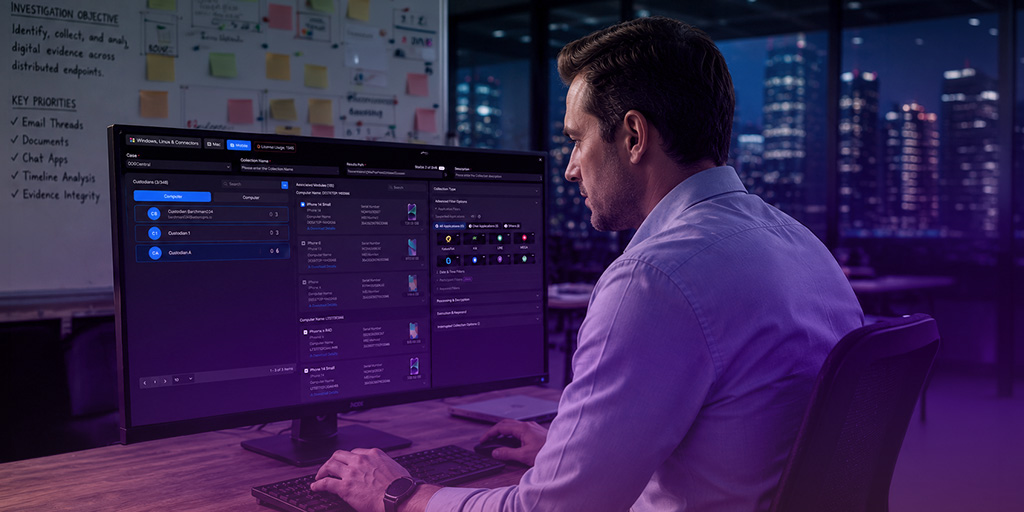
Playbook-Driven Litigation Readiness: The Strategy Legal Leaders Can’t Skip

Playbook-Driven Litigation Readiness: The Strategy Legal Leaders Can’t Skip
Host: Jenny Hamilton, Chief Legal Officer, Exterro
Guest: Patrick Butts, Director of Legal Operations and Information Governance at Hilltop Securities
Litigation isn’t slowing down—and the stakes are only getting higher.
In this episode of Data Xposure, host Jenny Hamilton, Exterro’s Chief Legal Officer, is joined by Patrick Butts, Director of Legal Operations and Information Governance at Hilltop Securities, to explore what it really means to be litigation ready in today’s data-driven world.
They go beyond reactive crisis response to reveal why a smart, end-to-end playbook is essential—not just for legal efficiency, but for enterprise risk management. From proactive data governance to streamlined eDiscovery workflows, Patrick shares how leading organizations are building litigation systems that are scalable, defensible, and built to perform under pressure.
Why it Matters:
Litigation readiness is a strategic imperative. Without the right systems in place, organizations face rising legal costs, regulatory exposure, and reputational damage. This episode delivers actionable insights for legal, IT, and compliance professionals ready to lead from the front.
Subscribe on Your Preferred Podcast Platform
Apple Podcasts | Spotify | YouTube
Episode Transcript
Jenny (00:04) Litigation isn't a matter of "if," it's "when". And when it comes, your ability to respond quickly and defensively can make or break your case, your credibility, and, of course, your budget. In this episode, we're taking on a question I hear all the time: "What does true litigation readiness look like?".
My name is Jenny Hamilton; I am the General Counsel at Exterro and host of Data Exposure. Joining me today is Patrick Butts, Director of Legal Operations and Information Governance at Hilltop Securities. At Hilltop, Patrick has helped design a new litigation readiness playbook that goes beyond deadlines—systems that embed defensibility and drive real efficiency across Legal and IT. We'll talk about the hidden friction points that slow us down in our legal response, how to align cross-functional teams before we get to the crisis, and where eDiscovery fits into the bigger picture. Welcome, Patrick.
Patrick Butts (01:06) Thank you, Jenny. It's a pleasure to be here. I consider myself in the presence of eDiscovery royalty; it really is an honor and a privilege.
Jenny (01:15) Well, thank you for that! And you're a fellow Texan. I'm from Southeast Texas, but you're from a whole different place called East Texas—San Augustine. I understand there's a long-running debate about whether San Augustine or Nacogdoches is the oldest town in Texas. Where do you fall on that?
Patrick Butts (01:45) I'm from what we call the "Piney Curtain" down in East Texas. I was born and raised in San Augustine. To this day, the debate on which town is oldest continues. As my father-in-law says, "I like either; I'll take both". I actually went to college at Stephen F. Austin State University in Nacogdoches. But I have to say, it makes sense that San Augustine is the oldest because if you're coming East to West, you hit San Augustine first. I'm partial to both, though.
We still have family property there. When I need to be therapeutic—which in this industry is probably daily—I go down and drive around on tractors and bulldozers to get some of that frustration out. It’s a great place to relax.
Jenny (02:52) Do you offer that to the greater eDiscovery community? I feel like we need to have a retreat.
Patrick Butts (02:55) Yeah, we should have the Exterro Exchange down in East Texas. Instead of "car bashing," we’ll do tractor driving.
Jenny (03:08) I think there may be some liability to that, Patrick.
Patrick Butts (03:10) It’s funny, ChatGPT helped me draft an indemnification and a waiver, so I have one ready to go!
The Path to Legal Ops
Jenny (03:18) Let's talk about the legal side of things. You started your career as a paralegal and spent many years in that role before your current General Counsel personally recruited you. How did that relationship develop?
Patrick Butts (03:51) We were both working in the corporate transactions department of a large law firm here in Dallas. He came on as a new associate, and as paralegals, we did some training to help the new attorneys get up to speed. About a year after he left that firm, he called and asked if I’d be interested in coming over to the securities business. I wasn't sure I knew much about that industry, but I went to talk to them, and that was almost 21 years ago.
I joined because we worked well together, and there was much more upward mobility inside a corporation than as a paralegal at a law firm. His mentality was: "You can do just about as much as you feel big enough to do". He really gave me the reins to take flight.
Building a "KNOW" Department
Jenny (05:30) In the early 2000s, you were part of an advanced eDiscovery program during some M&A activity. Tell us how that positioned you.
Patrick Butts (05:53) Being in financial services, we are heavily regulated. Back then, we were the recipients of an internal investigation—a "sweep" by regulators. We were spending about $2,500 a gig for collection, processing, and review. I’m not that good at math, but I could tell that was unsustainable. We looked at bringing eDiscovery in-house. Because we started so early, we became quite advanced. Our early process was held together with "duct tape and bailing wire," but it worked because we had a playbook.
Jenny (07:18) You’ve said the relationship between Legal and IT is the most important relationship in legal operations. What cemented that for you?
Patrick Butts (07:42) IT and Legal speak such different languages. When I walk the halls, people are almost afraid to make eye contact because they don't want to get "called into Legal". IT was afraid that if they said something, it would be wrong, and we would "slap them with a ruler" . eDiscovery brings those two business lines together because you have to.
When we implemented Exterro a few years ago, the first thing I did was look for who in IT was going to help. Once they realized what Legal wanted, and Legal understood IT’s concerns, the lights went off for both sides. As my friend Rich Robinson says, we want to be a "KNOW" department, not a "NO" department. We want to know about issues on the front end rather than trying to defend them on the back end.
The Implementation Playbook
Jenny (09:32) You believe in a one-hour standing weekly meeting between Legal and IT. What does that look like?
Patrick Butts (09:45) Initially, nobody from IT was joining because I called it the "eDiscovery Call" and they were afraid of the term. I changed the title to "IT/Legal Collaboration," and suddenly everyone started joining. We have an agenda driven by Legal, and if a topic comes up—like O365—and no one is there to speak to it, we find out who handles that and add them to the group. Now, we even have the CISO and CIO involved.
Jenny (12:40) You also captured this alignment in a playbook. What prompted that?
Patrick Butts (12:50) We have four separate lines of business. Each was doing eDiscovery, but once we had one tool (Exterro) for the entire process, we realized we had to have a playbook so we were all doing the same thing, the same way. We got the SMEs from Exterro in the room to walk us through best practices. We had some "brisk" conversations with IT on the best way to do things, but learning from each other has been incredible.
Our vision was that someone could come in, pick up this playbook, and follow the process from the start of a matter all the way to remediation and Information Governance. It’s also for defensibility and reasonableness. If you have something in writing, you better follow it—it’s better to not have a playbook than to have one and not follow it.
Software as a Management Tool
Jenny (16:13) You have a great philosophy: "There’s no such thing as perfect software because it’s not going to fix your problems; it just helps you manage them".
Patrick Butts (16:33) Hardware and software will always have problems. You still have to have people involved to manage the landscape. It’s like a herd of goats: you hire a Great Pyrenees to protect them, but you still have to feed, water, and love that dog for it to do its job. You can't just turn the dog loose and walk away.
Jenny (18:14) One piece of software that can be a game-changer is the Employee Change Monitor. How are you using it?
Patrick Butts (18:29) When I saw that during the proof of concept, I said, "Stop the show; I don't need to see anything else"! If a custodian is on legal hold and they leave the company, you may never know it without a monitor. Their laptop could be redistributed or wiped, which is alarming. Now, if a manager on hold leaves or changes roles, we are automatically notified. I can breathe a little easier.
Risk vs. Defensibility
Jenny (19:53) How do you deal with outside counsel taking positions that you feel should defer to Legal Ops?.
Patrick Butts (21:01) Years ago, when we were looking to bring eDiscovery in-house, outside counsel asked, "Are you sure? There’s a lot of risk". I said, "Don't I have that risk already? You aren't going to take the risk for my document collection, are you?". The risk is mine no matter what, so why not save the cost by keeping it in-house?.
I compartmentalize it: "Legal risk" is avoiding trouble, whereas "defensibility" is providing sound behavior to mitigate that risk. The playbook builds a defensible program in writing. The last thing any of us want is to be in front of a judge for spoliation or an adverse inference recommendation because something was lost.
Closing Advice
Jenny (25:34) What advice would you give someone earlier in their career?.
Patrick Butts (25:55) Look for opportunities to add value, and be willing to take a risk and speak up. Networking is paramount—attend conferences and never stop learning. Look at certifications like CEDS (Certified e-Discovery Specialist) or IGP (Information Governance Professional). Conferences are like group therapy; you hear others talk and realize, "I guess we aren't doing too bad after all". Don't be afraid to volunteer—otherwise, you might get "voluntold"!
Jenny (27:52) If you take one thing from today, let it be this: Litigation readiness is a function of design. The right playbook makes you faster, smarter, and more defensible. Thank you for listening to Data Exposure. Remember, what's hiding in your data could cost you everything.