From the Frontlines of Data Risk: Live Insights from the Industry's Leading Conference
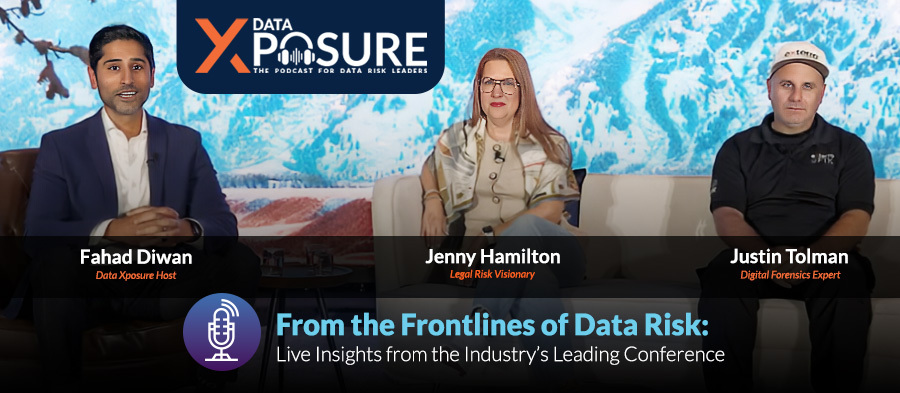
From the Frontlines of Data Risk: Live Insights from the Industry’s Leading Conference
Hosts: Fahad Diwan, Jenny Hamilton, Justin Tolman
What happens when the sharpest minds in legal, privacy, and security come together to solve the world’s hardest data problems?
Recorded live onsite at the close of Exterro’s XChange 2025 in Denver—the industry’s leading conference for managing enterprise data risk—this special edition of Data Xposure brings you inside the conversations shaping the future of data governance, compliance, and security.
Join hosts Jenny Hamilton (Legal), Fahad Diwan (Privacy & Governance), and Justin Tolman (Forensics) as they debrief the most urgent insights, candid challenges, and unexpected takeaways from three packed days of sessions, panels, and hallway conversations with the people responsible for protecting sensitive data inside global organizations.
You’ll hear:
- Why AI governance emerged as the theme across legal, privacy, and security tracks
- How leaders are navigating regulatory fatigue and building resilience under pressure
- What teams are doing today to improve forensic readiness and cross-functional alignment
- What surprised even the most seasoned data professionals this year
Whether you were at XChange or missed it, this episode captures the pulse of where data risk is headed—and what enterprise leaders are doing to stay ahead of it.
Thanks for tuning in to the episode 3 of Data Xposure. Don’t forget to subscribe so you never miss an update. For show notes, resources, and to connect with us, visit exterro.com/data-xposure
Subscribe on Your Preferred Podcast Platform
Apple Podcasts | Spotify | YouTube
Episode Transcript
Fahad Diwan
Welcome everyone to another episode of Data Exposure. It's a very special episode today. We're live at XChange, the premier conference for data risk professionals and extero customers. I'm here with my podcast co-hosts. We have our legal commander in chief, Jenny Hamilton. We have our digital forensics expert and serial diet Pepsi drinker, Justin Tolman.
A lot of great insights we've had Nancy Grace come and speak. We've had Marcia Clark come and speak. And we've had leaders from around the world come and share their insights with us. And my co-hosts and I have learned a lot.
So Jenny, what have been your key takeaways so far? What has really stuck with you?
Jenny Hamilton
One thing that's been resonating with me is how complex our work is as legal professionals, compliance, forensics, privacy.
And while there's this ongoing challenge of the convergence almost or overlap of our work and still the up level of sophistication of what we need to do to execute well. One of the things that I was really impressed by when you talk about Marcia Clark and Nancy Grace and even our panel breaking down the Karen Read trial is this huge social cultural influence on our work, that people are paying attention, seeing these stories, these cases play out in the news, and they're more aware than they ever have been of what we do for a living.
And the mistakes that get made and impact perceptions, particularly credibility of the case, and that we can take that back to our organizations and remind them that even though we've come a long way in building our programs and executing at a high level on our work, we still can't follow the complacency because as far along as we've come, there's even new challenges, particularly with digital evidence.
Justin Tolman
Yeah, and I've noticed that what people are trying to figure out right now is they're tired of the siloed approach to their jobs. They have things that involve entire organizations and they're stuck in their silos and they're looking, they came looking to this conference for ways to break out of that. How many times have you guys heard siloed, we're siloed, we're siloed and they're looking for better ways to collaborate not just with their communication but with the workflows.
How do I move the data to the teams that matter? And this is often an issue with forensics where I'm focused is we're kind of this tight-knit group, right? We want to hold onto our data, we want to do our investigations but no investigation, especially in enterprise and big organizations, corporations, are done that way. It's not a one department gig.
And fortunately, they've came to us to look at their solutions, look at how we're approaching these, talk with other professionals, and learn how other people are solving these issues. So it's been a great conference.
Fahad Diwan:
Right, and to your point about silos, one thing I've heard a lot about is AI, right? Everyone's talking about AI, AI risk. We want AI technologies that we can leverage to make our lives easier, but we also want those AI technologies to be used in a way that is responsible and ethical.
Now, business units are using AI across the board, right? I mean, we're using it in our workflows. We can't really approach it in a siloed way anymore, right? What do you think, Jenny? How do you, what have you been some of your key takeaways with respect to AI and managing AI and using AI responsibly within an organization?
Jenny Hamilton
I think it's comes down to making sure that you are surfacing the use cases and the developers don't always know what those are gonna look like. And so to understand what people are using it for, like for me, I'm tired of drafting legal holds the manual way and I would love to automate the legal hold preservation process even more and rely on AI to do what it knows how to do and that draft letters, draft notices.
And it's so exciting to see come to life and working closely between Legal and our product development team, how they shared that right after the keynote of, hey, this is one of the ways you can use Extero Intelligence, Extero Assist for Workflow. Now you can upload the complaint, and we can help draft and surface some of the key issues based on the causes of the action. And that before was so manual and grinding.
And I'm really excited to see how we're going to just continue to move that across the workflow. But a lot of it's going to depend on what our customers want to use it for.
Fahad Diwan
And with respect to our customers, weren't there a lot of great insights that came out of the Innovation Lab? You know, yesterday at the customer appreciation dinner, there were all those ideas and one of them was leveraging AI to get better insights on the release notes or something to that. Do you remember?
Jenny Hamilton
Yeah, it was earlier in the process the more we can use it because it's now beyond like summarization and it's how do we use it to, you know, redact documents and use it for FOIA requests or subpoenas. But again, it's early in the process where it makes sense.
But to your point about responsibility, AI that requires in any company, including ours, legal and product and engineering and the experts like you and privacy and digital forensics to have an ongoing iterative conversation. And so this fits nicely where where I see people going, organizations embedding the different groups to break down the silos like
product attorneys are having their day right now who are advising on AI. And maybe that's one benefit of AI is helping to break it down.
Fahad Diwan
Yeah, what do you think Justin?
Justin Tolman
I think our customers are looking for AI that they can trust, right? That's the main big thing right now. And that's one of the ways I'm seeing how we've approached it in our verticals is how do we isolate the AI to do the tasks that you guys just described, but in a way that I'm confident in the output, that it's not going out sharing my data outside or being allowing that data to be trained or it's not hallucinating because it pulled some random thing off the internet.
It's all about building that trust with the system so that your results, because we work in a legal environment, right? It's gotta be validated. It's gotta be trustworthy. And we talked about that in our panel on the Karen Read trial about trust and proper handling of that data and AI is like any emerging technology, it requires change and policy. I think the difference with AI is the speed at which everybody's grasping onto it and the speed at which it changes.
But fortunately, we're able to present at least the beginnings of the platform. We're still in the early stages of everything, but one that you can trust with your data and your workflows.
Jenny Hamilton
That's table stakes, right?
Fahad Diwan
And I love that point about trust. I think we need to be able to trust the AI. And that builds a connection with the AI. And one thing that, you know, when I tied to Nancy Grace's talks, I asked a bunch of people, what did you think? What did you think? What did you think? And they all said the same thing. I loved it when she cried. I was like, you loved it when she cried? Why? Because it felt like she was genuine. She had put a guard down and I could trust what she was saying.
And so this idea of trust, whether we're dealing with people or technology, seems to be central to what it means for humans to connect. What were... What's something about Nancy Grace's talk that you really liked?
Jenny Hamilton
I liked hearing about her career trajectory. And I knew the story about how she had gone to law school, why she had become a prosecutor, and how it's translated into this desire to have a positive impact and a focus on doing what's right and justice. So of course, you asked the lawyer this question, that’s going to be a huge part of it.
Especially right now when we talked again about Karen Reed and how things aren't perfect and people make mistakes. But you definitely want to be part of a larger community that's trying to do the right thing and have a positive impact and also foster for me particularly foster this trust in the rule of law and that we're going to do things not just to get the right results, but we're gonna follow the how is gonna be important in getting to that result.
Fahad Diwan
Well said, Jenny. And so for our listeners who weren't there for your session, can you tell us a little bit more about it? What did you and Justin talk about?
Justin Tolman
Well, so it's kind of interesting because most of our customers are from corporations. They're not officers working homicide trials, which this was. But there was a lot of things from that trial that can be applied to any type of investigation, regardless of the field. And what we focused most on is the importance of collection and validation, but mostly on the diligence of doing things the right way, even when maybe there's time pressures or political pressures. And by political, I mean within a company or whatever.
And those types of things, because is the old saying, haste makes waste, right? And you're willing to cut corners and when you start cutting corners, things are gonna go wrong. And they're, in my opinion, there's no more important step of any case, law enforcement, corporate, doesn't matter, than collection. You gotta successfully collect your data and then everything else can build off of that strong foundation.
Jenny Hamilton
And also, like, one thing that was missing the Cure and Read trial is just documenting what you're doing, why you didn't do certain things. And we talked about that with the panelists prepping for the panel. And my view of it is that's what the technology is there to help us do. We can't possibly do all these things manually. And that's what I'm relying on, even our own tools in my work, to make sure that it's building that in so that when it's time to tell the story, that I feel good about the story we're telling.
Fahad Diwan
Right. And that key point about automation is one I've heard time and time again from our customers in the panels. Everyone takes a lot of pride in the work that we do because it has such a deep impact on society, like you mentioned earlier. And we want to do it well. And people are realizing to do that well, we have to leverage automation. We have to leverage AI with guardrails.
So what was one takeaway with respect to automation that Jenny, Justin, you really picked up from these sessions at XChange?
Jenny Hamilton
For me, it was the case study early on about how one of our customers used Extero Intelligence to surface relevant documents and took the corpus from 160,000 to 3,300. There's so many things about that that are important, but also for the person responsible for that program to be able to show the company, like, hey, we can, you know, be effective, we can be efficient, we can be good stewards of the money that you give us for the tools and the people and we can kind of have it all now.
Fahad Diwan
Yeah, that's well said. We can have it all. What about you, Justin?
Justin Tolman
The takeaways that I've picked up from people regarding automation is they want to do what the fun part of the job, which is analysis and reading and determining, OK, this is actionable, this is not. The mundane is what they want automated, is calling those documents down or filtering out or prepping the evidence for review. And those are the types of things that you're going to click the same buttons or you're gonna go through the same process.
Let's automate that so you can get to what you do best is analysis or review or determining what is actionable. And that's what people are most impressed with with the automation that we're working on.
Fahad Diwan
And I had a conversation with one of our customers last night at the customer appreciation dinner and she was telling me the same thing. I love the analytical part of my role. She was in records retention and helping to operationalize it. She I don't really like the part where I have to go and collate all these documents. I'm glad that we have these great tools to help us automate that.
And I'm the data mapping guy. So one key takeaway for me was build a data map, and you have to keep a data map constantly up to date. You can't really do that manually. And having an up to date and comprehensive data map can help you respond to breaches more effectively, have more targeted e-discovery, comply with privacy regulations.
And so, key takeaways, let's do rapid fire. What's one quote, one key takeaway that you want our listeners to remember about your time here at XChange, realizing that many of them maybe unfortunately weren't able to come? So what's one thing you would share with them?
Jenny Hamilton
We talked a lot about technology and process, that it's really the connection, this is the opportunity, the best time to be able to connect, share stories, get the key takeaways you can take back that are practical and useful, and develop relationships that we need to do our job. And we also need it for our own enjoyment of what we do and to share that with each other.
Fahad Diwan
Absolutely. I love that point about enjoyment.
Justin Tolman
That's I look for in a conference is practical takeaways that I can take home. And I feel like we've done a great job, focusing on that, our customers have been able to provide theirs. We're not the end all be alls of our fields. We don't have all the answers, but with our customers and everybody here, that exchange of ideas, it's the practical takeaways that they can go back and make their labs a little better, come back the next year and share how it improved and continue that positive feedback loop.
Fahad Diwan
So for you, a key takeaway was just the amount of practical insights you got while at the event.
Justin Tolman
Yep, every time.
Fahad Diwan
And for me, it was twofold. One was be emotionally vulnerable. People seemed to really resonate with it, and they trust you. So it takes a lot of courage, especially for me, I have a hard time crying, but I'm going to try to cry one of these days. You'll just see me bawling.
That's our new goal for the podcast. On the podcast. And the other thing was leveraging AI, leverage it responsibly. Yeah. So that's it for our very special episode of Data Exposure live here at XChange. Thank you, Justin. Thank you, Jenny.
It's great hosting a podcast with these two. They're amazing. Please stay tuned for our next episode. Like, subscribe, and share.
My name's Fahad, and I look forward to, or one of us looks forward to talking to you at our next episode.