After the Alert: How AI-Driven Forensics Turns Endpoint Activity into Evidence

Authored by Robert Bond, Product Marketing Manager, Digital Forensics at Exterro
Security teams are not short on alerts. They are short on answers they can trust, document, and act on.
EDR, XDR, SIEM, and other detection tools identify suspicious activity, surface risk, and help teams respond quickly when something looks wrong. But detection is not investigation. An alert rarely explains what happened, how far it spread, which endpoints were affected, whether sensitive data was accessed or moved, or what evidence supports the next decision.
That is where investigations slow down. Analysts move between tools, build queries, wait for endpoint responses, collect data, review artifacts, correlate activity, and document findings. While that work happens, processes stop, memory changes, logs roll over, files move, and endpoint activity continues.
Exterro ARMOUR for FTK is built for the moment after the alert, when teams need to move from suspicion to evidence-supported answers. It connects AI reasoning to Exterro’s live endpoint reach and proprietary forensic technology. Investigators describe what they need to understand in plain language. AI helps coordinate the supported workflow. Exterro performs the authorized forensic work. The investigator reviews the evidence and decides what it supports.
To learn more about Exterro ARMOUR for FTK, read the full press release here.
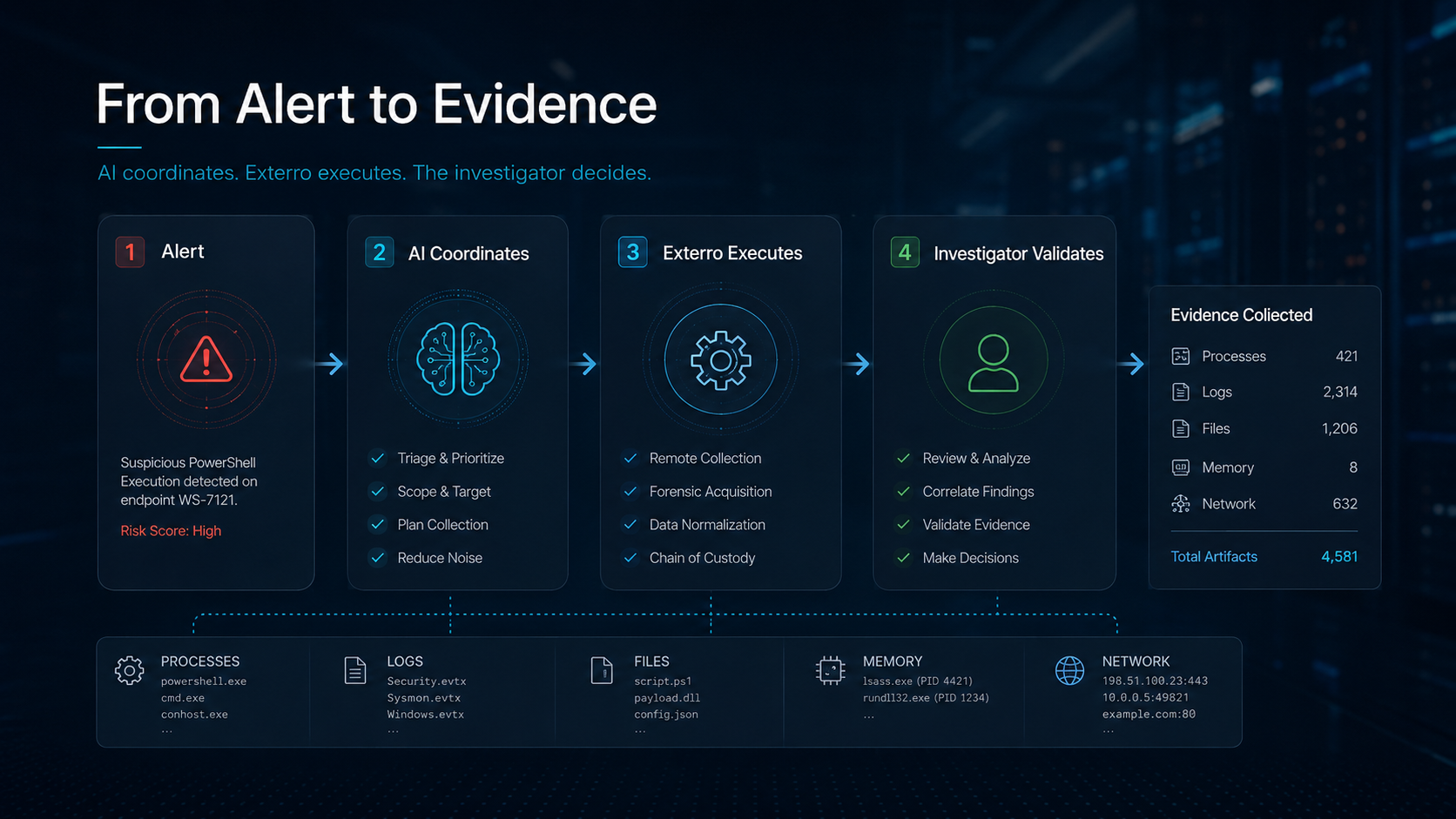
The AI coordinates. Exterro executes. The investigator decides.
In a customer evaluation, Exterro’s agentic remote-investigation workflow identified a five-hour evidentiary window in seconds — a task that previously required hours of manual investigation. Persistent endpoint connections also eliminated the five-to-60-minute polling delays common in legacy agent architectures, removing repeated waits across multi-step investigations.
That is the point: faster movement from alert to scope, from suspicion to findings, and from findings to defensible action.
Detection Tools Identify Risk. Investigators Still Have to Prove What Happened.
Detection tools can flag unusual processes, risky files, unexpected network activity, suspicious user behavior, or endpoint activity that may indicate compromise. But once the alert fires, teams still need to answer the questions that determine what happens next:
- What actually happened?
- Which endpoints, users, files, processes, and systems were involved?
- Did the activity spread or remain isolated?
- Was sensitive data accessed, staged, copied, synchronized, or transferred?
- What evidence supports containment, remediation, legal action, regulatory response, insurance reporting, or executive communication?
Those questions require endpoint evidence, forensic artifacts, and investigator-reviewed findings. The evidence may live across processes, network connections, registry entries, scheduled tasks, event logs, browser history, downloads, removable media activity, cloud synchronization artifacts, file system metadata, memory, and other endpoint sources.
Detection points teams in the right direction. Investigation establishes what the evidence proves.
Generic AI Can Summarize Information. It Cannot Perform Forensic Investigation by Itself.
AI has changed expectations for investigation workflows. Security, legal, compliance, HR, and insider-risk teams now expect faster answers, less manual work, and a more natural way to interact with data.
That expectation is right. The mistake is assuming generic AI alone can solve the investigation problem. A language model can summarize, classify, draft, reason, and recommend. But by itself, it cannot inspect live endpoints, acquire memory, parse forensic artifacts, collect evidence, query endpoint activity, or establish a defensible investigation record.
The risk is not only getting a slow answer. The greater risk is getting a confident answer that is not grounded in evidence.
Exterro ARMOUR for FTK is built around a different model:
- AI helps interpret the investigative objective.
- Exterro’s endpoint agents and forensic technology perform the authorized work.
- Results return for human review, validation, refinement, and decision-making.
- The investigator remains responsible for scope, interpretation, and conclusions.
This is the difference between asking AI what might have happened and using AI to help drive a controlled forensic workflow.
Exterro ARMOUR for FTK Turns Investigation Objectives into Authorized Endpoint Actions.
Traditional investigation workflows force analysts to translate every question into a sequence of manual tool steps. An investigator may need to know whether an endpoint shows signs of compromise, whether ransomware activity spread, whether an employee transferred sensitive files, or whether a custodian accessed specific cloud services before departure.
Getting from that question to evidence often requires multiple steps:
- Identify the right endpoint, user, file, process, or artifact.
- Choose the right tool or query method.
- Collect or inspect the required endpoint data.
- Wait for endpoint response or agent check-in.
- Review the results and refine the inquiry.
- Document what the evidence supports.
Exterro ARMOUR for FTK changes the starting point. The investigator begins with the objective, not the tool sequence. The approved AI model helps interpret the objective and coordinate supported investigative actions. Exterro performs the authorized inspection, collection, acquisition, and analysis. The investigator reviews the results and determines what the evidence supports.
The workflow is straightforward:
- Define the objective. The investigator asks the investigative question in plain language.
- Coordinate the investigation. The approved AI identifies supported actions and relevant evidence sources.
- Execute the work. Exterro agents and forensic technology perform the authorized forensic activity.
- Validate the findings. The investigator reviews the results, examines the evidence, refines the inquiry, and owns the conclusion.
The value is not that AI replaces the investigator. The value is that AI removes unnecessary friction around the investigator.
A Ransomware Alert Should Not Require Hours of Manual Tool Switching Before the Team Understands Scope.
Consider a common situation: a ransomware alert fires on one endpoint. The team needs to know whether the activity is isolated, whether related processes are running elsewhere, whether files were staged or encrypted, whether suspicious network connections exist, and whether other endpoints show related indicators.
In a traditional workflow, the analyst may need to move across multiple tools, query endpoint data, wait for agent check-ins, collect artifacts, review logs, and escalate to a forensic specialist before the team can establish a clear picture.
With Exterro ARMOUR for FTK, the investigator can begin with the objective: determine whether the ransomware activity spread and identify the affected systems. From there, the workflow can help coordinate supported forensic actions across available endpoints:
- Inspect running processes, services, drivers, network connections, and scheduled tasks.
- Review event logs, startup activity, registry entries, file system metadata, and recent endpoint activity.
- Search for targeted files, indicators, or suspicious artifacts.
- Acquire system or process memory where supported and appropriate.
- Return results for investigator review, refinement, and documentation.
AI does not magically resolve the incident. It helps the investigator get to the right forensic work faster, with less manual translation between the question and the evidence required to answer it.
That is the operational value: faster movement from alert to scope, from suspicion to findings, and from findings to defensible action.
The MCP Layer Connects Approved AI Models to Exterro Forensic Capabilities Without Letting AI Bypass Control.
Exterro ARMOUR for FTK uses Model Context Protocol to connect supported AI models to Exterro forensic capabilities. That matters because enterprise teams already have AI governance requirements, including approved models, restricted models, data-handling rules, regional requirements, and security policies.
The purpose is not to force every organization into one model. It is to let organizations connect a supported, approved AI option to Exterro’s forensic execution layer in a controlled way.
That control model matters:
- The AI communicates through the MCP layer.
- The AI does not directly connect to endpoint agents.
- The AI does not independently reach into endpoints.
- The AI does not generate the underlying forensic evidence.
Exterro provides the endpoint access, investigation infrastructure, and forensic technology required to perform the work. AI helps plan, query, organize, and summarize. The investigator controls the objective, reviews the results, and makes the decision.
That architecture is central to the trust model.
Live Endpoint Reach Reduces the Waiting That Slows Multi-Step Investigations.
Time matters in endpoint investigations. Processes stop, memory changes, logs roll over, files are deleted or moved, users continue working, and attackers adapt. Many endpoint workflows still depend on periodic polling, which creates delays that compound across multi-step investigations.
Exterro ARMOUR for FTK is designed to reduce that waiting by connecting AI-assisted investigation workflows to live endpoint reach.
That matters when investigators need to inspect:
- Running processes, users, network connections, ports, services, and drivers.
- Scheduled tasks, registry entries, startup activity, operating systems, and installed software.
- File system metadata, targeted files, event logs, memory, and endpoint activity.
- Browser history, downloads, recent files, removable media activity, cloud synchronization, and archives.
It also matters when teams need deeper forensic analysis using MFT and USN journal queries, system or process memory acquisition, Windows Event Logs, and supported Volatility, Sigma, Chainsaw, and YARA analysis.
The practical value is simple: less waiting, more investigating, and faster access to evidence while it still matters.
Remote Forensic Depth Helps Corporate Teams Investigate More Than Security Alerts.
Corporate investigations do not all start with malware. Some begin with a ransomware alert. Others begin with suspected data exfiltration, an employee departure, a legal hold, a policy violation, a fraud concern, a regulatory inquiry, or unexplained endpoint behavior.
The trigger changes. The investigation bottleneck does not. Teams still need to identify relevant systems, inspect activity, collect targeted evidence, analyze artifacts, connect findings across sources, and determine what the evidence supports.
Exterro ARMOUR for FTK supports the endpoint-level evidence corporate teams often need across several investigation types:
- Incident response: Establish what happened, assess scope, inspect affected endpoints, and collect time-sensitive evidence.
- Compromised endpoint and malware investigations: Examine processes, persistence, memory, logs, files, and network activity.
- Insider risk and employee matters: Investigate file access, removable media activity, browser behavior, cloud synchronization, archives, and recent documents.
- Legal, compliance, and regulatory matters: Support targeted endpoint investigation, custodian evaluation, preservation planning, and documentation of investigative activity.
Different teams may start with different questions. They still need the same thing: faster, evidence-grounded answers.
Targeted collection is part of that value. Not every investigation should begin by collecting everything. Exterro ARMOUR for FTK helps teams focus on the evidence needed to answer the question, reducing unnecessary data movement and helping legal, compliance, HR, privacy, and regulatory teams stay aligned with scope.
Human Validation Keeps Accountability Where It Belongs.
AI can accelerate investigation work, but it should not own the conclusion.
That is why Exterro ARMOUR for FTK keeps the investigator in control. Role-based controls determine who can access the integration and which endpoints they can investigate. Supported actions are documented. AI helps coordinate and organize the work, but consequential decisions remain with the investigator.
That matters because a finding may influence containment, remediation, employee action, legal strategy, regulatory disclosure, insurance response, or executive reporting. Exterro ARMOUR for FTK accelerates the path to evidence without removing the investigator from the decision.
The Strategic Shift Is From Alert-Driven Response to Evidence-Driven Investigation.
The future of investigation is not more disconnected tools, more alerts, or generic AI summaries detached from endpoint evidence. The future is AI connected to forensic execution.
That means investigators can ask better questions, move faster through supported workflows, reach endpoint evidence sooner, and reduce repetitive manual steps without giving up control.
AI can coordinate the investigation while Exterro performs the forensic work. Findings remain grounded in endpoint data and forensic artifacts. Investigators stay responsible for scope, validation, interpretation, and decisions.
That is the shift Exterro ARMOUR for FTK enables: from alert-driven response to evidence-driven investigation.
The outcome is not AI for the sake of AI. It is a better investigation model: remote endpoint investigation, accelerated by AI, executed by Exterro, and controlled by the investigator.
Ready to see Exterro ARMOUR for FTK in action? Schedule a demo today.